What a team is, and how you can tell
A group becomes a team at the moment its members cannot get the result alone. Everything else in this guide follows from that one fact, because a task that can be split into independent pieces never forces anyone to talk.
There are three levels of working together, and most workplaces run on the first two. Coordination is sequencing: I finish, you start. Cooperation is helping: I lend you my time when you ask. Collaboration is the third, where the result belongs to nobody in particular and everyone has to keep talking until it exists. A department can coordinate for years without anyone learning how anyone else thinks.
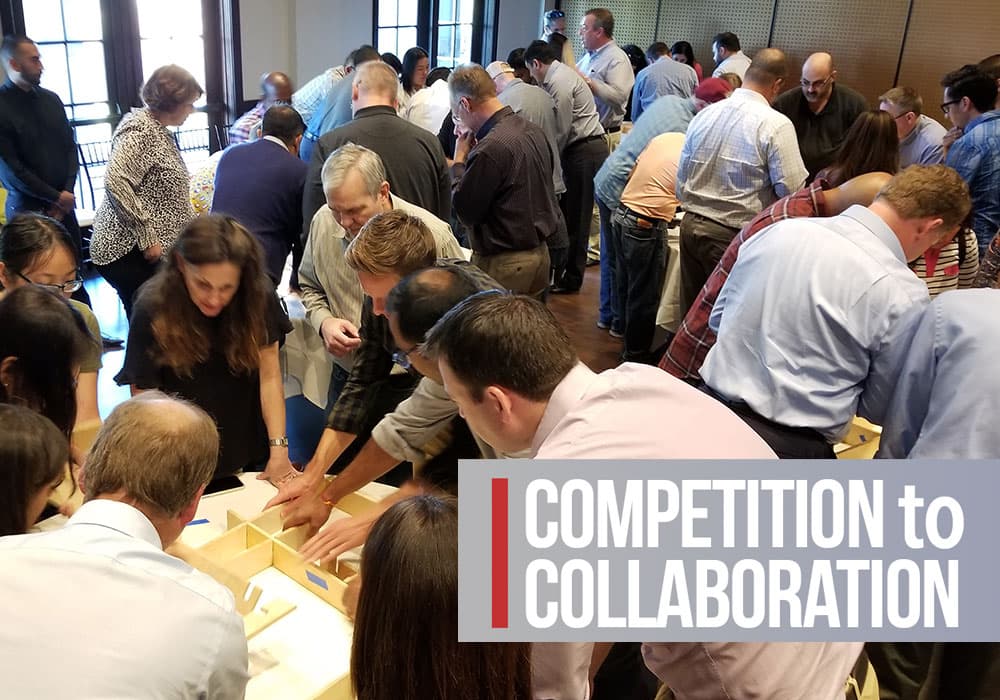
We watched it happen with a Fortune 500 company that brought twelve teams from three offices to Boston. Each team had an hour to prepare a wooden 3D puzzle and then sixty seconds to assemble it, and the whole room won only if every team finished. Three did. Those three had been given extra information during the prep hour and assumed everyone had it. Nobody had asked, and nobody had told. The room recognized itself immediately, and the debrief turned into an agreement on how the three sites would pass information from then on.
That is the pattern behind most of what this guide covers. Teams rarely fail on competence. They fail on the gaps between people: information that one person holds and assumes is shared, trust that was never tested, a disagreement nobody wanted to have, a style that reads as rudeness to the person on the other end. A well-designed task makes those gaps visible in an afternoon, and the models below give the room a language for what it just saw.
From our events
The stages every team goes through
Bruce Tuckman's 1965 model still describes what we see: forming, storming, norming, performing, and, since 1977, adjourning. The part most summaries leave out is that a team runs the whole cycle again every time its membership or its task changes, and that a facilitated afternoon runs it in miniature.
Forming is polite and quiet. People wait to be told what to do, watch the leader, and avoid anything that might cause friction. Storming is where the real preferences surface: who wants to lead, who disagrees with the plan, who thinks the whole thing is a waste of time. Norming is the settlement, when the team agrees, usually without saying so, on how it will decide, who does what and how it will argue. Performing is the state everyone wants, where the work gets done without much attention to the process. Adjourning, added by Tuckman and Mary Ann Jensen in 1977, is the ending, which matters more than it sounds for project teams and cohorts that will be reshuffled.
Two things the model does well and one thing to be careful about. It explains why a new manager who tries to skip storming ends up with a team that storms later, in private. What it does not do is run on a timetable: some teams norm in a morning and some never do, and a team can slide back a stage on one bad week. Treat it as a description of where a team is, never as a prediction of where it will be next quarter.
In a two-hour program the cycle runs end to end, which is the whole point. The first ten minutes are forming. The first hard task is storming, and our facilitators regard it as the most useful part of the day: a team that argues about how to build a bridge section is doing in the open what it does in emails all year. The norms arrive around the second round, when the team has stopped discussing who leads and started discussing how to win. The debrief at the end is adjourning done deliberately, with the lessons named before the group disperses.
| Stage | What it looks like | What the leader does | What a facilitated task does |
|---|---|---|---|
| Forming | Polite, quiet, waiting for direction | Set the goal and the roles out loud | An opener that mixes people and gives everyone a job |
| Storming | Competing plans, a skeptic or two, friction over who leads | Let the disagreement happen; keep it about the work | A first round hard enough to force a real plan |
| Norming | Agreement on how to decide and who does what | Write the norms down; make them explicit | A second round where the team applies what it learned |
| Performing | Work flows; process is invisible | Get out of the way; protect the team's time | A final round with a shared result the room can see |
| Adjourning | The project ends or the team is reshuffled | Close it properly; name what was learned | A debrief that turns the afternoon into commitments |
Trust, and the kind of safety that lets people speak
Amy Edmondson's research gave the thing a name: psychological safety, the shared belief that a team is safe for interpersonal risk. Teams that have it admit mistakes, ask for help and disagree in the open. Teams that lack it look calm and are not.
Edmondson's 1999 study of work teams found that the teams which reported more errors were often the better ones, because they were the ones willing to talk about errors at all. That inverts what most managers assume. A quiet team with no reported problems may be a team in which nobody feels safe reporting one. Roy has a version of the same observation from the floor: the sign of a team in trouble is disconnectedness, and the clearest signal is when people stop caring enough to complain and simply go silent.
Patrick Lencioni's five dysfunctions put trust at the base of the pyramid for a reason. Without it, teams avoid conflict, which produces artificial harmony; without conflict they never commit, because nobody argued for the decision; without commitment there is no accountability; and without accountability people attend to their own results rather than the team's. Our emotional intelligence facilitator, Steve Ockerbloom, draws the distinction that matters in practice. Most people define trust as doing what you said you would do. That is reliability, and it is necessary. The trust that changes a team is the willingness to say I need help with this, in front of colleagues, and to have that met well.
Trust is built in increments, and it is built by tasks rather than talks. An aerospace client puts 160 new hires through a ropes course every year, an egg drop, then a low wire the group crosses holding each other, then a leap from a forty-foot platform, and each stage asks for more trust than the one before. A two-hour program does the same on the ground: a first round where letting a teammate lead costs nothing, a second where it costs the round, a third where the whole result depends on it.
From our events
How teams communicate, and where it breaks
Team communication fails in three predictable places: information one person holds and assumes is shared, messages sent in a style the receiver reads differently, and channels that strip out everything except the words.
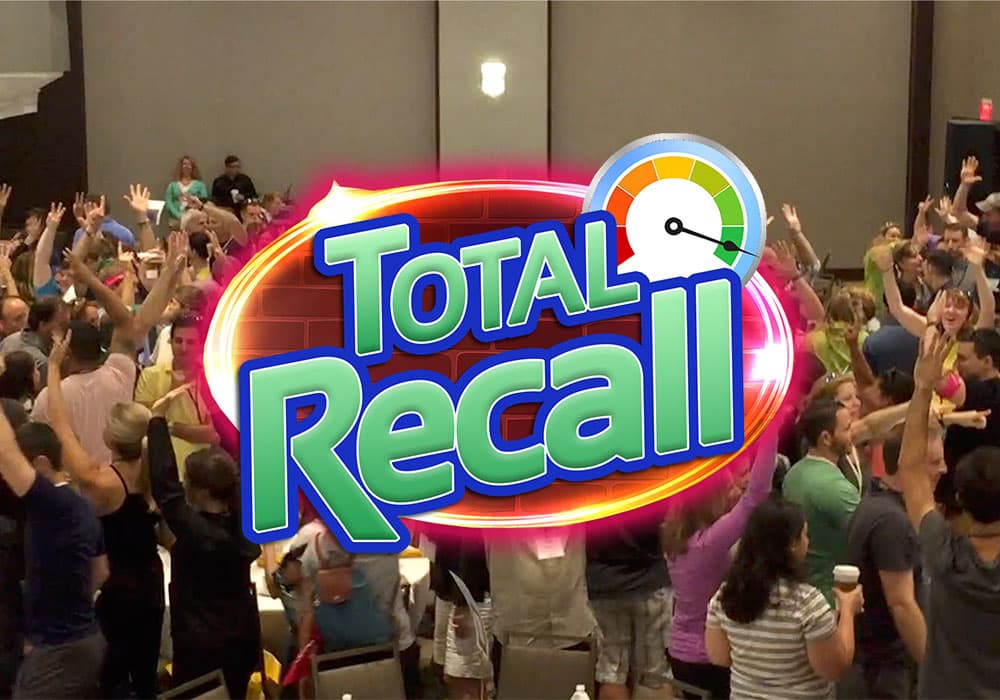
The first failure is the Boston puzzle. In every team, somebody knows something the others need without realizing they need it, and the others never think to ask. Total Recall is built to expose this: teams of five have to rebuild a small structure that only one of them, the looker, is allowed to see. The looker describes it to a buyer, runners carry instructions to a builder who has never seen it, and the team wins only if it invents what our facilitators call verification loops, the habit of repeating back what you heard before you act on it. Every team invents them eventually. The good ones invent them in round one.
The second failure is style. A direct person reads a careful colleague as evasive; the careful colleague reads the direct one as rude. Neither is wrong, and both are reading a style as a character. Behavioral assessments earn their place here, because they give a team a shared, neutral language for it. On DiSC, the direct person is high in dominance and the careful one in conscientiousness, and once the team can say so, the friction becomes a fact about styles rather than a judgment about people. The generational version of the same problem runs through every workforce now, with four cohorts who learned to communicate on different tools; the fix is to teach the differences rather than police them.
The third failure is the channel. A face-to-face request is far more likely to be granted than the same request by email, and people consistently underestimate the gap. Video keeps most of the signal and chat keeps almost none. This is the practical argument for putting a distributed team in a room at least once a year, and for doing the difficult conversations, the ones about roles and disagreements, in person when it can be arranged.
| What breaks | What it looks like | What fixes it |
|---|---|---|
| Information held by one person, assumed shared | Three teams finish, nine never had the brief | Verification loops: repeat back, then act |
| Style read as character | Direct reads as rude, careful reads as evasive | A shared language for styles, from an assessment |
| Wrong channel for the message | Hard conversations moved to chat and then abandoned | Roles, disagreements and feedback in person or on video |
| Silence mistaken for agreement | No questions in the meeting, objections afterwards | Ask the quiet person directly; managers speak last |
| Nobody owns the handoff | Two teams each think the other has it | Name the owner of every seam, out loud |
Styles and roles: what the assessments measure
DiSC, Myers-Briggs, Belbin, CliftonStrengths and emotional intelligence each measure something different, and each is useful for exactly one thing: giving a team a shared vocabulary. Used for anything else, they turn into labels.
DiSC sorts behavior along four dimensions, dominance, influence, steadiness and conscientiousness, and is the fastest to learn and the most booked with us, because a team can read its own map in an afternoon. The Myers-Briggs Type Indicator describes preferences on four pairs and gives a common language for how people take in information and make decisions; its weakness is that people remember their four letters and forget the caveats. Belbin describes nine team roles from what people actually do in a team, with observers rating you as well as yourself, which makes it the most honest of the set and the one that says behavior can change. CliftonStrengths ranks 34 talent themes in four domains, executing, influencing, relationship building and strategic thinking, and is best used to map a whole team's strengths rather than an individual's. Emotional intelligence assessments measure how well someone reads and manages their own reactions and other people's.
Two rules make them work. First, the assessment is done before the day, and the day is spent on the team map rather than the individual reports. Second, the language is descriptive, never diagnostic. The moment a team starts saying she is a high D as an explanation for a decision, the tool has become a label, and a do-it-yourself Myers-Briggs session with no facilitator produces exactly that. Our facilitators are certified in the instruments they run, and a good part of what they do is stop the room from typecasting itself.
The generational lens is a style question too, and worth a paragraph because it runs through every team. The workforce is now roughly a sixth Baby Boomers, a third Generation X, a third Millennials and a sixth Generation Z, each of which learned to communicate on a different set of tools. The mistake is to treat the youngest cohort's preferences as a problem to correct. Seat teams by tenure so every table mixes the cohorts, give them a task, and the mentoring goes both ways.
| Tool | What it measures | Best for | Watch out for |
|---|---|---|---|
| DiSC | Behavior on four dimensions | A shared language for style, fast | Letters used as labels |
| Myers-Briggs (MBTI) | Preferences on four pairs | How people take in information and decide | Do-it-yourself sessions that typecast |
| Belbin Team Roles | Nine roles, self and observer rated | Who does what in a team, and the gaps | Needs the observer ratings to mean anything |
| CliftonStrengths | 34 talent themes in four domains | Mapping a whole team's strengths | Individual reports read in isolation |
| Emotional intelligence | Self-awareness, regulation, reading others | Leaders and teams under stress | Treating it as a score rather than a practice |
From our events
Conflict: the amount is irrelevant, the handling is everything
High-performing teams disagree as often as everyone else. What they do differently is argue about the work, in the open, and settle it. The teams that never disagree are avoiding, and avoidance is the most expensive conflict style there is.
The Thomas-Kilmann model describes five ways people handle a disagreement: competing, collaborating, compromising, avoiding and accommodating. None is wrong in itself; the trouble is that most people have one default and use it whatever the situation. Steve Ockerbloom teaches the same thing in more physical terms, fight, flight, freeze or appease, where appease is the manufacture of artificial harmony, and he has a name for the most common small conflict in a meeting: idea duck hunting, where somebody floats an idea and somebody else shoots it down before it has cleared the table.
Silos are conflict at the scale of departments, and they have a structural cause that no amount of goodwill fixes. Roy's example is the one we use at intake. Put a hundred salespeople in a room and ask them to share best practices, and none of them will, because they compete for the same customers. Put thirty managers from across the country in the same room and they share everything, because they compete for nothing. If two teams are in conflict, look first at what they are measured on. If the measures compete, the teams will.
This is why Competition to Collaboration is built the way it is. Two groups spend the first half in separate rooms setting benchmarks on a set of tasks, believing they are competing. Then the rule changes: each group has to hand the other everything it learned, and success is measured by how much the other group beats your benchmark. The moment the room understands that the only way to win is to make the other side better is the moment most of them recognize their own organization. A Procter and Gamble team told us afterwards that they had come in needing to be a little less competitive and a little more collaborative, and left having learned they could help each other and still be successful.
- Say what you are measured on, and ask what they are; if the measures compete, fix that first
- Argue the work, never the person; move a disagreement about a plan away from a disagreement about a colleague
- Give every idea a hearing before anyone shoots at it; the leader enforces the rule
- Name your default style, and the other person's, out loud when it helps
- Decide who decides, before the argument, so it can end
- Have it in person or on video, never in a chat thread
- Close with what was decided and who owns it; silence afterwards is avoidance, never agreement
What a two-hour program shows you about your team
The team-performance programs are diagnostics as much as activities. Each one simulates a specific failure of teamwork, and the debrief is where the team names the version it recognizes from its own week.
Bridge to the Future gives every team of ten one section of a bridge to build from cardboard and tape, and at the end the sections have to join and hold the weight of everyone who built them. The mechanic is tolerances: your section is only as good as its fit with the sections on either side, which means the team leaders have to hold project meetings across teams while the building is going on. A Hendrick Automotive group said afterwards that it made them realize how much they needed each other and that they had to come together to resolve issues, which is the sentence the program is designed to produce. Pipeline does the same with a marble run, where each sub-team builds one section that has to connect to its neighbors and the marble has to make it end to end.
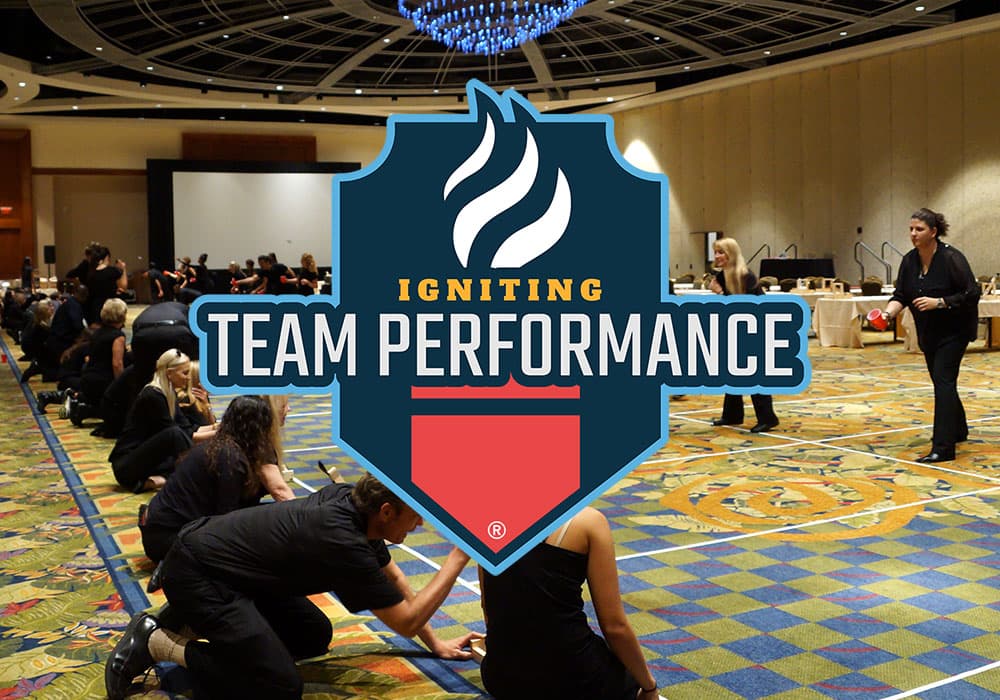
Igniting Team Performance runs a cycle: a challenge, a debrief, a reflection, a harder challenge. Each initiative is built so that the plan the team made last time is now insufficient, and the debrief after each is where the lessons get named by the team rather than by the facilitator. Total Recall isolates communication and roles, as described above. Competition to Collaboration isolates silos.
The debrief is the product. A facilitator closes every program with fifteen to thirty minutes in which the team says what helped, what got in the way, and what it will do differently on Monday, and the last of those is written down. A library team told us the best part of Igniting Team Performance was the debrief, sharing with each other what they did in their circles. The activity creates the evidence; the debrief turns it into a decision.
| Program | What it simulates | What the team usually names in the debrief |
|---|---|---|
| Competition to Collaboration | Departments measured against each other | We compete when we should share; who owns the handoff |
| Bridge to the Future | Teams whose work has to fit with other teams' work | Nobody checked the tolerances until the end; we need cross-team meetings |
| Pipeline | Sequential handoffs, each section dependent on the last | The seams are where we lose things |
| Total Recall | Information held by one person, relayed through others | We never repeat back; we assume |
| Igniting Team Performance | A team that has to improve its own process round by round | Our first plan was the problem; we did not adjust it |
From our events
Putting it to work with a new or reorganized team
A team that has just been formed, merged or reshuffled is in forming whether it likes it or not. The manager's job in the first month is to get it through storming on purpose, in the open, rather than by accident, in private.
Start with the goal and the roles, said out loud and written down, because a team in forming will invent both if nobody supplies them, and will invent them differently in every head. Then decide how decisions get made before the first decision arrives: who decides, who is consulted, what happens when two people disagree. Then set the communication norms, which channels for what, how fast a reply is expected, and where the hard conversations happen. None of this takes more than a meeting, and most new teams never have the meeting.
Then give the team a first shared task with a deadline that it cannot complete by splitting the work, and let it storm. A facilitated program is the cleanest version, because the task is designed, the facilitator keeps the argument about the work, and the debrief turns the afternoon into commitments; a real project with a short deadline is the next best. Either way, the manager's role during the storm is to keep it in the open and away from personalities.
Close the first month with the two-question debrief, standing in a circle: what have you brought to the teams you have worked with, and what can people count on you for, with managers answering last. Write the answers down. Then put the next checkpoint on the calendar, because the team will re-form the next time someone joins or leaves, and the models in this guide are only useful to a manager who expects that and plans for it.
- Goal and roles written down and read out in the first week
- How decisions get made, agreed before the first decision
- Communication norms: which channel for what, expected reply times, hard conversations in person
- A first shared task with a deadline that cannot be split
- Storming kept in the open and about the work; the manager resists settling it by fiat
- The two-question debrief at the end of month one, managers last, answers written down
- A behavioral assessment when the team is under 25 and the friction is about style
- A checkpoint on the calendar for the next time membership changes
Sources
- Tuckman, B. W. (1965). Developmental sequence in small groups. Psychological Bulletin
- Tuckman, B. W. and Jensen, M. A. C. (1977). Stages of small-group development revisited. Group and Organization Studies
- Edmondson, A. (1999). Psychological safety and learning behavior in work teams. Administrative Science Quarterly
- Friedman, R. (2021). 5 things high-performing teams do differently. Harvard Business Review
- Bohns, V. (2017). A face-to-face request is 34 times more effective than an email. Harvard Business Review
- Lencioni, P. The Five Dysfunctions of a Team. The Table Group
- Thomas-Kilmann Conflict Mode Instrument, overview
- DiSC Profile, What is DiSC?
- Belbin, The nine Belbin Team Roles
- Gallup, The 34 CliftonStrengths themes
- US Surgeon General, Framework for workplace mental health and well-being
- BEST, Tuckman's stages of group development
- BEST, Generational Communication Differences in the Workplace (eBook)