What counts as team building
Team building is a structured activity, run by a facilitator, in which a group has to work together to reach a goal and then talks about how it went. The talking is what separates it from a party.
Every real program has the same six parts: a business goal the organizer can say out loud, a facilitator from outside the group, an activity that nobody can finish alone, full participation, a debrief while the experience is fresh, and something the group takes back to work. Remove the goal and you have an outing. Remove the debrief and you have a game. Remove the facilitator and the most senior person in the room runs it, which is the dynamic the day was supposed to interrupt.
It is also worth saying what falls outside the definition. A lecture on teamwork, since people already know they should communicate. A trust fall. Training, which changes what individuals can do, while team building changes how a group behaves. And the happy hour afterward, however good the happy hour is.
| Socializing | Training | Team building | |
|---|---|---|---|
| Purpose | Enjoy each other's company | Teach a skill to individuals | Change how the group works together |
| Who leads | Nobody, or the host | An instructor | A facilitator from outside the group |
| What people do | Talk, eat, drink | Listen, practice | Solve a shared problem under a clock |
| What changes after | Familiarity | Individual competence | Trust, communication, how decisions get made |
Where it came from
The idea that a group's sense of itself changes its output is a century old, and every decade since has added a layer.
Between 1924 and 1932, researchers at Western Electric's Hawthorne Works in Chicago changed the lighting, the breaks and the pay of small groups of workers and found that output rose almost regardless of what they changed. The variable that mattered was the attention paid to the group and the identity the group developed while being studied. Elton Mayo's write-up of those experiments is the starting point of the human relations movement, and of the claim that how people feel about their group is a productivity input.
In 1965 Bruce Tuckman reviewed fifty studies of small groups and gave the field its vocabulary: forming, storming, norming and performing, with adjourning added later. Tuckman's point was that the storming is normal and that a group can be moved through it faster on purpose. That is the theoretical license for team building as an intervention rather than a reward.
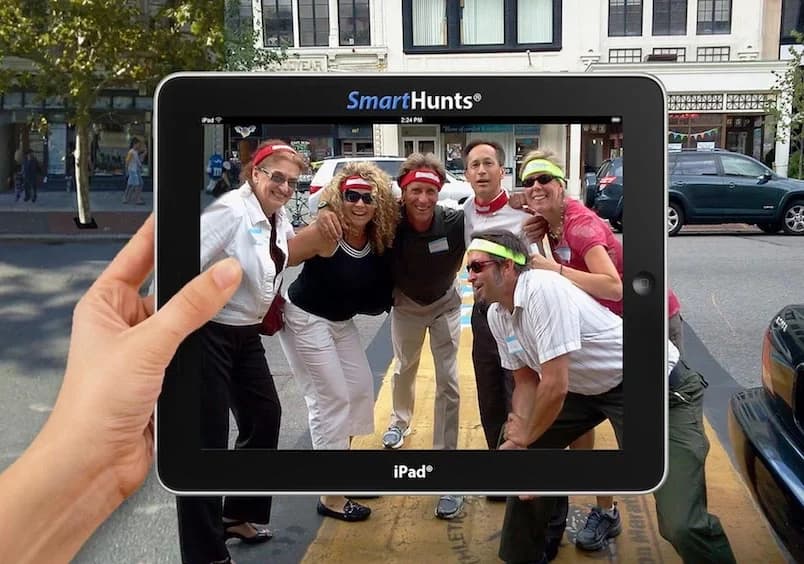
The 1980s and 1990s were the ropes-course years: outdoor challenge programs, retreats and the rise of professional facilitation. The 2010s put technology in the activity itself. Best Corporate Events was founded in 2010, the year the iPad launched, and built its first scavenger-hunt app for it that same year, which is why a BEST program scores itself live and the debrief can start from data. In 2020 the whole industry moved to video conference for a year, and what came back was hybrid: one event with people in the room and people on screen.
Why it works: three mechanisms
Strip away the activities and team building is doing three things to a group: making people depend on each other when the stakes are low, giving them a memory they share, and making the group's habits visible.
The first is interdependence without consequence. At work, relying on a colleague you do not know is a risk. In a program, the risk is a lost round. A Stanford experiment by Priyanka Carr and Gregory Walton found that simply cueing people that they were working together on a task, even apart, made them persist 48 to 64 percent longer and report more interest in the task. The activity manufactures that cue for two hours, across the whole group, with people who would not otherwise choose each other.
The second is a shared positive experience. Harvard Business Review's 2021 study of high-performing teams found that their members were far more likely to express positive emotions with colleagues, to joke and to compliment each other, and that recognition from peers motivated people more than pay. Those habits are hard to instruct and easy to start in a room where a team has just built a bicycle for a child it is about to meet.
The third is visibility. Under a clock, a group does what it always does, only faster and in the open. The team whose loudest member decides everything, the two departments that never share information, the new hire nobody asks: all of it shows in the first ten minutes. The facilitator's job in the debrief is to point at it kindly, and the group's job is to decide what to change. That conversation is where an activity becomes a result.
From our events
What the research says
The strongest evidence is for engagement, and engagement is what a well-run program moves. The weakest evidence is for a single event changing a culture on its own.
Gallup's meta-analysis of employee engagement, covering more than 100,000 business units, found that units in the top quartile of engagement had 23 percent higher profitability, 81 percent lower absenteeism and 18 to 43 percent lower turnover than units in the bottom quartile, depending on the industry's baseline turnover. Gallup also reported that only 31 percent of U.S. employees were engaged in 2024, a ten-year low. Team building alone will never move an engagement score, but the things it practices, being heard, working with people you trust, seeing the point of the work, are the things Gallup's twelve questions measure.
On collaboration, the Carr and Walton experiments are the cleanest result: the feeling of working together, on its own, changes effort. Harvard Business Review's high-performing-teams research adds that the teams that perform best are the ones whose members meet more often, including socially, and who trade appreciation freely. On the group-development side, Tuckman's stages remain the standard model, and the practical finding that matters for a planner is that groups regress: a team that was performing will storm again after a reorganization or a round of layoffs, and a program at that moment shortens the storm.
What the research does not support is the one-off. There is no credible study showing that a single afternoon changes retention a year later. The organizations that see the numbers move treat team building as a cadence, and measure it the way the next chapters describe.
| Claim | Evidence | Strength |
|---|---|---|
| Engaged teams are more profitable and stay longer | Gallup Q12 meta-analysis, 100,000+ business units | Strong, correlational, replicated |
| Feeling part of a team makes people work longer at a task | Carr and Walton, Stanford, controlled experiments | Strong, experimental, small samples |
| High-performing teams share more positive interactions | Harvard Business Review, 2021 survey of 1,000+ workers | Moderate, self-reported |
| Groups move through predictable stages and can regress | Tuckman, 1965 review of 50 studies | Foundational model, widely used |
| One event changes culture on its own | None found | Unsupported; cadence and follow-up are required |
What team building changes, by goal
A program is chosen for a goal, and each goal has a format that serves it and a number that shows whether it worked.
The mistake most planners make is to choose the activity first and back into a reason. The order that works is the reverse: name the one thing that keeps going wrong, pick the format built for it, and decide before the event what you will look at afterward. The table is the short version of that conversation; the guides linked below it are the long version for each goal.
| Goal | What the program has to do | What to measure after |
|---|---|---|
| Communication | Force information to move between people who rarely talk | Cross-team requests, meeting length, a two-question pulse |
| Trust and psychological safety | Put people in a position to ask for help and get it | Who speaks in meetings, pulse survey on speaking up |
| Collaboration across departments | Mix departments in teams and make the win depend on the mix | Handoffs, shared projects delivered on time |
| Morale and belonging | A shared win, ideally for someone else | eNPS, absenteeism, who shows up to the next one |
| Onboarding | Get a cohort to know each other and the company in one day | Time to productivity, 90-day retention |
| Leadership | Rotate who leads and debrief what leading felt like | Delegation, direct-report feedback |
| Conflict | Surface the disagreement in a low-stakes setting with a facilitator | Escalations, turnover on the team |
| Giving back | Build something real for a named charity | Participation rate, employer-brand mentions |
When it does not work
Team building fails in the same six ways, and all six are decided before anyone walks into the room.
It fails when there is no goal, so the activity is chosen for being fun and the group senses it is being entertained rather than helped. It fails when it is mandatory fun: announced as a treat, scheduled over lunch, run by the manager. It fails when the format is wrong for the size of the group, which is why a program for thirty people and a program for three thousand are different programs and not the same one scaled up. It fails when there is no debrief, so the lesson stays in the room. It fails when it is a one-off, an annual apology for the other 364 days. And it fails when nothing is measured, because then nobody can say it worked and the budget disappears next year.
- No goal the organizer can say in one sentence
- Run by the boss instead of a facilitator
- Wrong format for the headcount or the room
- No debrief, or a debrief that is a speech
- One event a year with nothing between
- Nothing measured before or after
Roy's rule
How to measure it
Decide what success looks like before the event, ask five questions the day after, and look at three numbers ninety days later.
Before: write down the goal and the one or two numbers that already exist for it. If the goal is communication between two departments, count the cross-team requests in the month before. If it is retention on a team, note the current rate and the exit-interview themes. This is your baseline, and it is what gives the after any meaning.
The day after: a five-question survey, anonymous, two minutes. Was it worth your time? What is one thing you learned about someone you work with? What will you do differently this week? What should we change next time? Did you have fun? The first and last questions tell you whether people will come to the next one; the middle three tell you whether anything happened.
Ninety days later: look at the baseline numbers again, and add attendance at the next event, which is the most honest measure there is. If the same people who dreaded the first one show up early to the second, the program is working. For customer-facing teams, watch satisfaction scores and the tone of reviews. For any team, watch absenteeism, which moves before turnover does.
| When | What | How |
|---|---|---|
| Four weeks before | The goal and its baseline | One sentence, one or two existing numbers |
| Event day | Participation and the debrief | Did everyone take part; what the group said it would change |
| Day after | Five-question pulse | Anonymous, two minutes, keep the wording for next time |
| Ninety days | The baseline numbers, and attendance at the next event | Same sources as before; look for the pattern, and expect it to build over a year |
From our events
How often, and how big
Quarterly beats annual, two hours beats a day, and the right group size is the size of the group that has the problem.
Cadence matters more than scale. A two-hour program every quarter, each with a goal and a debrief, does more than a full-day offsite once a year, because the group gets four chances to practice what it said it would change. The annual event still has a place, usually inside a conference or sales meeting, where the goal is the whole company and the format has to hold hundreds of people at once.
Size follows the goal. A team with a communication problem is fixed as a team, in a program built for thirty. A company that has just merged two divisions needs both divisions in the room, which might be four hundred. A charitable build for a sales meeting of three thousand is a logistics exercise as much as a team building one, and the guide to large groups covers what changes at that scale. Inside any program, the working unit stays the same: teams of eight to ten, because that is the largest group in which everyone has to speak.
From our events
Sources
- Gallup, Q12 Meta-Analysis: The Relationship Between Engagement at Work and Organizational Outcomes
- Gallup, U.S. Employee Engagement Sinks to 10-Year Low (January 2025)
- Carr and Walton, Cues of working together fuel intrinsic motivation, Journal of Experimental Social Psychology (2014)
- Harvard Business Review, 5 Things High-Performing Teams Do Differently (2021)
- Tuckman, Developmental sequence in small groups, Psychological Bulletin (1965)
- Harvard Business School Baker Library, The Human Relations Movement: Harvard Business School and the Hawthorne Experiments