What team building can and cannot fix
A team event changes how people feel about each other and about being noticed. It leaves what they are paid, how much is on their desk and who they report to exactly as it found them. Sort the problem into one of those two piles before booking anything.
The complaints that show up in an engagement survey fall into two groups. One group is about the conditions of the job: compensation, workload, career path, the manager, the commute, the tools. Nothing that happens in a ballroom on a Thursday afternoon touches any of those, and a team that has been asking for a raise for a year will read a game show as an answer to a question it did not ask. The other group is about connection and recognition: people who have never met the colleagues they depend on, new hires who have never met the old hands, a department that last shared a room before the reorganization, work that gets done without anyone saying it was done well. Those are the problems a well-run event moves, and it moves them the same day.
The distinction matters because the first pile is where most retention actually lives. Gallup's manager research puts about 70 percent of the variance in team engagement on the manager, and its replacement-cost work prices a departure at one half to two times the person's salary. An event does not change the manager. What it can do is give a manager who is trying a setting where the team sees a different side of each other, and give a team that is fine on conditions but thin on connection the thing it is missing.
So the rule at intake is one question: if this team's engagement number were high, what would be different about their week? If the answer is about the work itself, fix the work and hold the budget. If the answer is that they would know each other, trust each other, and feel that someone had noticed, book the event and design it for exactly that.
| What the survey says | Usually caused by | Can an event help? | What actually helps |
|---|---|---|---|
| We are underpaid | Compensation | No | A market review, and honesty about the answer |
| Too much work, too few people | Workload and staffing | No | Hiring, priorities cut, deadlines moved |
| No path forward here | Career structure | Partly | Development plans; a workshop can start the conversation |
| My manager never listens | The manager | No | Manager training, or a change of manager |
| I do not really know the people I work with | Distance, growth, turnover | Yes | An event built to mix people, then a cadence |
| Nobody notices what we do | Recognition | Yes | Public recognition in the room, and a habit afterwards |
| We have been through a hard year | Change, cuts, a bad quarter | Yes, after the facts are out | Leaders in the room, a shared win, something to point to |
| The new people and the old people are two teams | Onboarding, hybrid schedules | Yes | Seat by tenure, timed tasks, a debrief |
What the research says
Engagement is low almost everywhere, pay explains less of satisfaction than people assume, and the two conditions team building can create, which are connection and being seen, are the ones the public-health and management research keep landing on.
Start with the baseline. Gallup's State of the Global Workplace puts worldwide engagement at 23 percent, and its US tracking has hovered around a third for a decade. The same tracking shows the share of employees who say someone at work cares about them as a person fell from 47 percent in early 2020 to 38 percent. McKinsey's Great Attrition research found 40 percent of workers at least somewhat likely to leave within six months, and the Bureau of Labor Statistics has median job tenure at about four years, under three for people in their late twenties and early thirties. Whatever else a company does, its people are looking around.
Then the surprise. A Harvard Business Review analysis of what predicts workplace satisfaction found compensation explained about 13 percent of it; the rest was the work, the people and the culture. The US Surgeon General's framework for workplace mental health names five essentials, and two of them, which are connection and community, and mattering at work, are precisely what a team event is built to deliver. The other three, protection from harm, work-life harmony and opportunity for growth, are the first pile from the chapter above.
On outcomes, the strongest evidence is for the charitable formats. Project ROI, a Babson College review, found a well-designed corporate responsibility program can lift engagement by up to 7.5 percent and productivity by up to 13 percent, and cut turnover by as much as half, and that a steady, modest program beats occasional grand gestures. Oxford's Wellbeing Research Centre links employee well-being to firm performance across a large sample of companies. And the Conference Board's engagement research found work location has no effect on engagement, which means a distributed team is worth the same investment as one in an office. What the research does not contain is a controlled study showing a single team building event raised an engagement score. We have run more than 4,000 events since 2019 and we do not claim one. What we claim is in the chapters that follow.
| Finding | Source | What it means for a planner |
|---|---|---|
| 23% of employees worldwide are engaged; about a third in the US | Gallup | The baseline is low everywhere; start from where your team is |
| Employees who say someone at work cares: 47% in 2020, 38% now | Gallup | Connection is the gap that has widened |
| Managers explain about 70% of the variance in engagement | Gallup | An event cannot substitute for the manager; put the manager in it |
| Replacing an employee costs one half to two times their salary | Gallup | One retained person pays for a year of events |
| Pay explains about 13% of workplace satisfaction | Harvard Business Review | Connection and recognition are most of the rest |
| Connection and mattering are two of five essentials for well-being | US Surgeon General | Design the event for those two, by name |
| A consistent CSR program: engagement +7.5%, turnover down up to 50% | Project ROI, Babson College | Charitable formats have the strongest evidence; repeat them |
Morale, engagement and retention are three different clocks
Morale is how the team feels this month. Engagement is its relationship with the work over a year. Retention is whether people are still here in two. An event moves the first immediately, the second through repetition, and the third only as part of something larger.
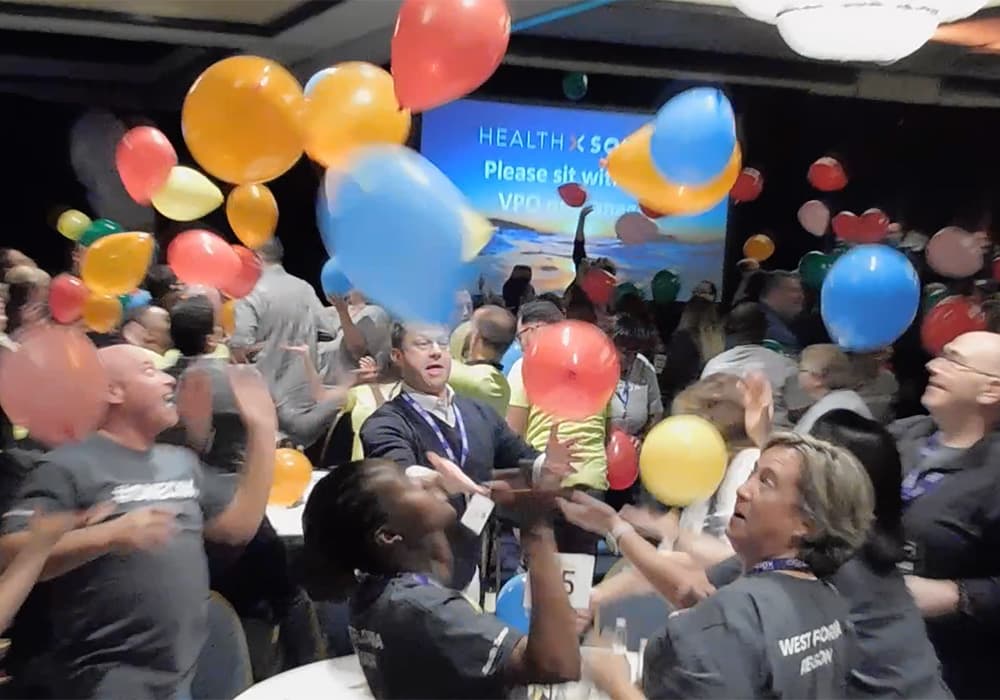
Morale is the fastest clock and the one an event moves on its own. Two hours of a shared win with a scoreboard, a bike built for a child, or a bridge that holds the whole team's weight changes the temperature of a room, and the effect lasts weeks. Clients tell us so in nearly the same words every time: the energy was off the charts, I have never seen my group like that, best staff meeting in ten years. Those are morale statements. They are real and they are worth having, especially after a hard stretch, and they are the whole of what a single event promises.
Engagement is slower. It is built from small repeated experiences of being connected and being seen, and one afternoon a year is too thin a layer to change it. Our own records show the pattern: most companies that book with us do it once, and among the ones that come back, the typical gap between events is about six months. The companies that treat it as a rhythm are rare, and they are the ones whose surveys move. An event every quarter, alternating a game show with a build or a charity program, gives a team four shared stories a year and keeps the new hires from ever becoming a separate tribe.
Retention is the slowest clock and the one most people are actually measured on. Team building contributes to it the way exercise contributes to health: through the conditions it creates, on a schedule, alongside the things that matter more. A company that fixes the manager, pays fairly and runs a quarterly event will keep more people than one that does two of the three. A company that runs the event instead of the other two will keep exactly as many as before, and spend the money.
From our events
The moments that call for an event
The requests that come to us with morale in the brief cluster around a handful of moments: the end of a hard quarter, a reorganization, a long stretch apart, a win worth marking, and the end of the year. Each one wants a different room.
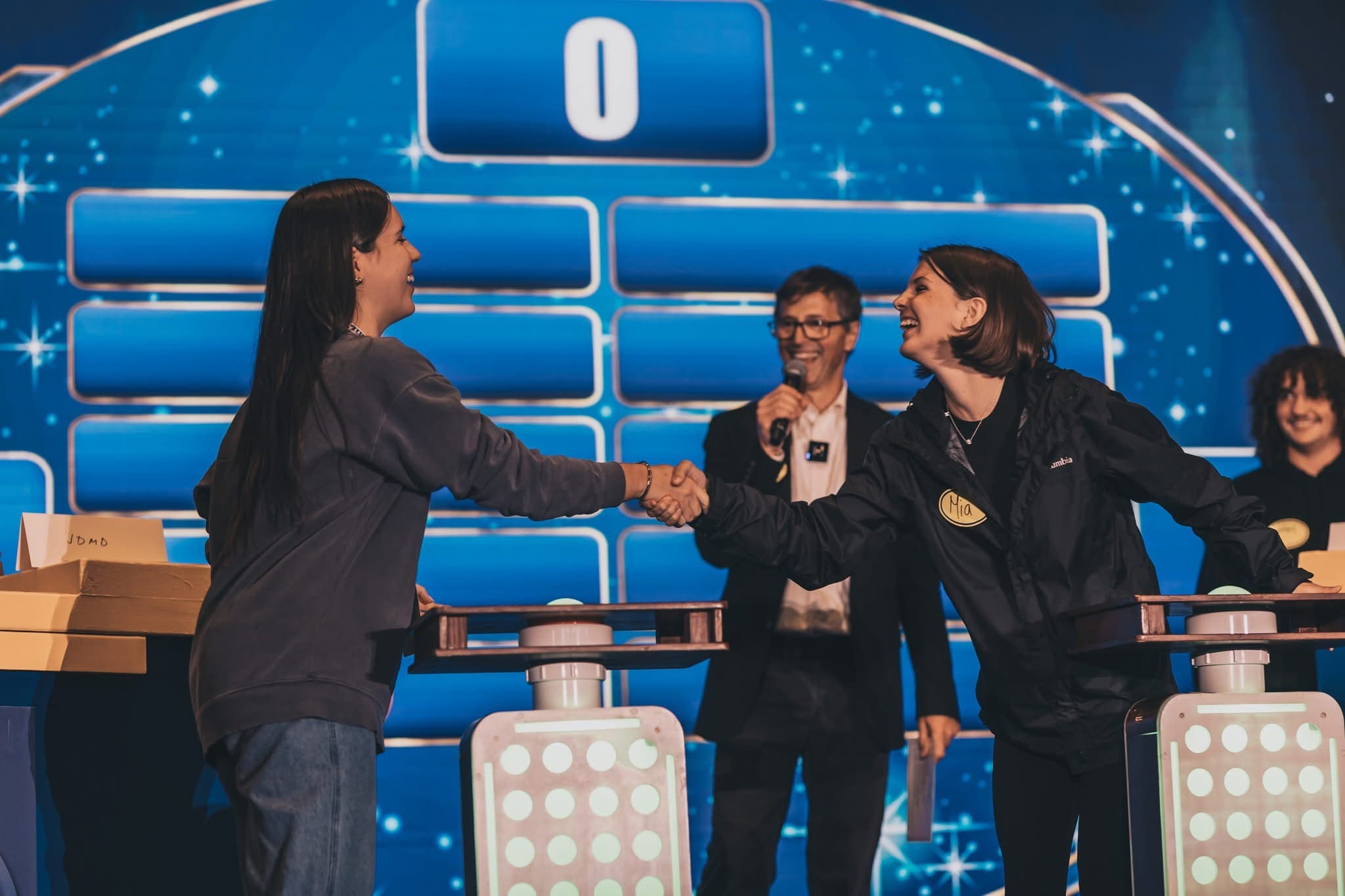
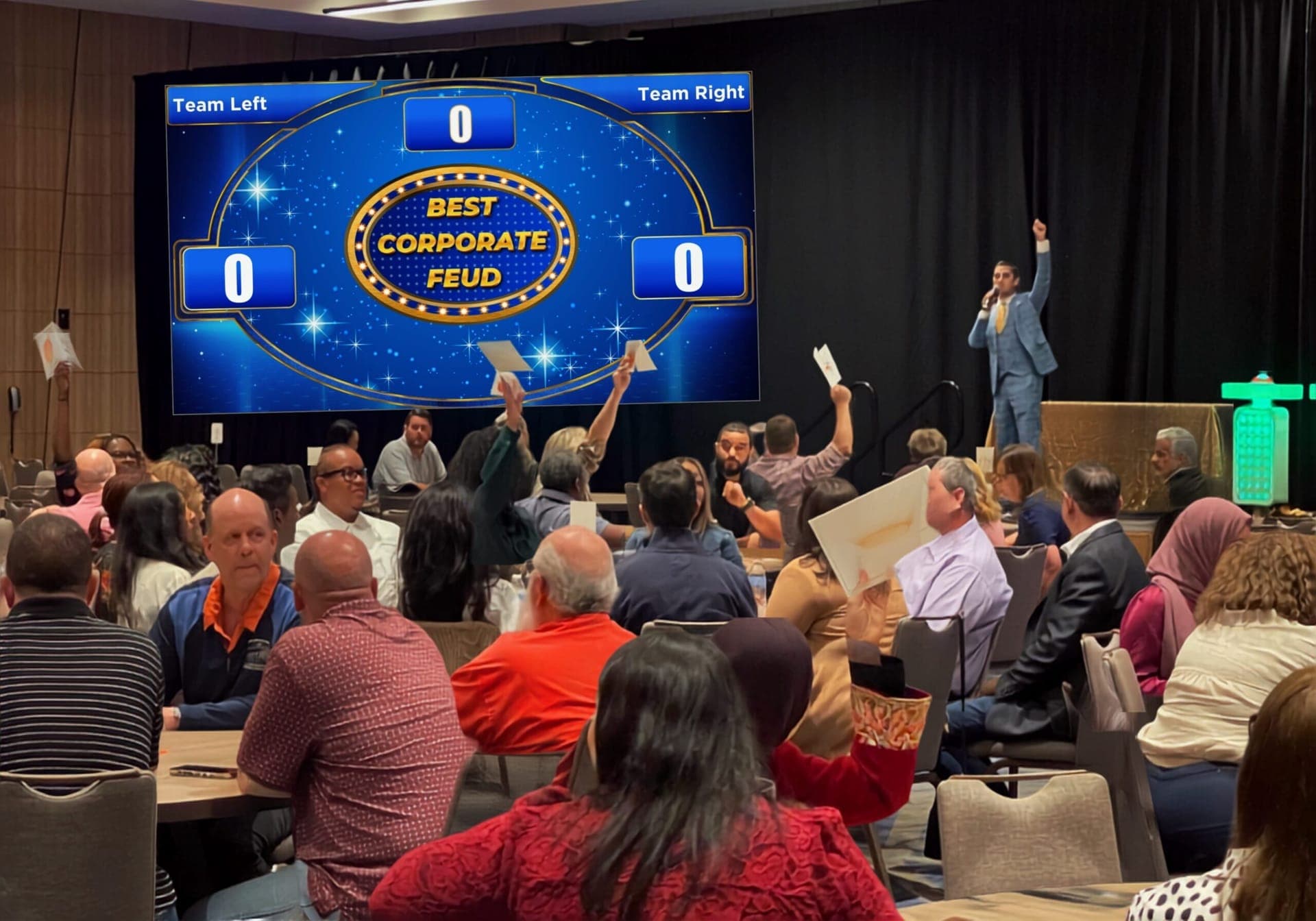
After a hard quarter, the team needs to laugh together at something with nothing at stake. A hosted game show does this better than anything else we run, because the competition is silly by design, everyone plays, and the scoreboard gives the room a story to tell on Monday. After a reorganization, the job is different: people have been reshuffled into teams chosen for them, and the event has to make those teams real. A build program in the new teams, or a hunt that sends the new reporting lines out into the city together, does that in an afternoon. After a long stretch of remote work or fast hiring, the brief is nearly always the same sentence, it has been a long time since we were all in one room, and the answer is a format that mixes people on purpose, seated by tenure rather than department.
Two calendar moments deserve their own note. Employee Appreciation Day, the first Friday in March, is a good excuse and a poor date: almost nobody books on the Friday itself, and the week around it is no busier for us than any other. Use the occasion, pick a Wednesday. December is the opposite: the busiest month in our year, half game shows and half of it virtual, because the holiday event is the one that has to include everyone including the field. Book it by early November.
The moment to decline is the one where the event is meant to deliver news. An afternoon of fun that ends with an announcement, or that follows one by a week, teaches the team that the next invitation means bad news is coming. Get the facts out first, wait until people have absorbed them, then gather.
| The moment | What the room needs | What we would run |
|---|---|---|
| End of a hard quarter | A shared laugh with nothing at stake | Best Corporate Feud, A Minute 2 Win It, Trivia Blast |
| After a reorganization | The new teams made real | Bridge to the Future or a build in the new teams; a SmartHunt by new reporting line |
| Long time apart, fast hiring | People mixed on purpose | Speed Networking, Competition to Collaboration, seat by tenure |
| A win worth marking | Recognition in front of peers | A game show with awards built in, or a charity build in the team's name |
| Giving the year a meaning | Something the team can point to | Bike Build Donation, Bears and Blankets, STEM Backpacks |
| Year end, everyone included | One event, in the room and remote | Virtual Office Party, a hybrid game show |
From our events
Rebuilding after layoffs
A team that has just watched colleagues leave does not need cheering up. It needs to know what is true, to see its leaders in the room, and to do something together that has an outcome it can trust. The order matters more than the program.
Nearly half of companies surveyed by ResumeTemplates going into 2025 expected to cut staff, so this is not a rare brief. The people left behind are carrying more work, doubting the next round, and watching leadership for signals. An event booked in the first two weeks reads as a distraction, and an event without the leaders in it reads as a consolation prize. Both leave the team more cynical than before.
The sequence that works has three steps. First, the facts: what happened and why, and what is true about the months ahead, said by the person who made the decision. Second, a gap, usually four to eight weeks, while the new workload settles and people decide whether they are staying. Third, an event whose shape matches the moment: collaborative rather than competitive, because a scoreboard splits a room that needs to feel like one team, and ideally charitable, because building something for someone worse off puts the team's own situation in proportion and gives the afternoon an outcome nobody can dismiss. A bike build, a wheelchair build or a care-package program does this; a game show, for once, does not.
Leaders participate. They are on teams, they build, they are not at the back on their phones. The debrief at the end is short and honest, run by the facilitator, and it asks the team what it noticed about working together rather than how it feels about the company. What people say in that circle is usually the first useful signal a leader gets about whether the team is going to be all right.
- The facts delivered first, in person, by the decision-maker
- A gap of four to eight weeks before any event
- A collaborative or charitable format; no scoreboard
- Leaders on teams, building, for the whole session
- Teams mixed across the new structure, seated by tenure
- A facilitator-run debrief about working together, kept short
- Something to point to afterwards: a photo, a running total, a donation letter
- A second event on the calendar within six months
From our events
Designing the room for connection and recognition
The program is a container. What lifts a team is who sits with whom, whether everyone has a job to do, whether the room hears their name, and whether the leaders are playing or watching.
Seat people by tenure, never by department. Sort the roster by start date and deal it across the tables so every team has someone from the first year and someone from the last, then give them a timed task rather than a discussion prompt. Nobody announces it as a mixing exercise. By the second round the new people are being coached by the old and the old are being out-thought by the new, and the mentoring goes both ways without anyone calling it that. This is the single design decision that does the most, and it costs nothing.
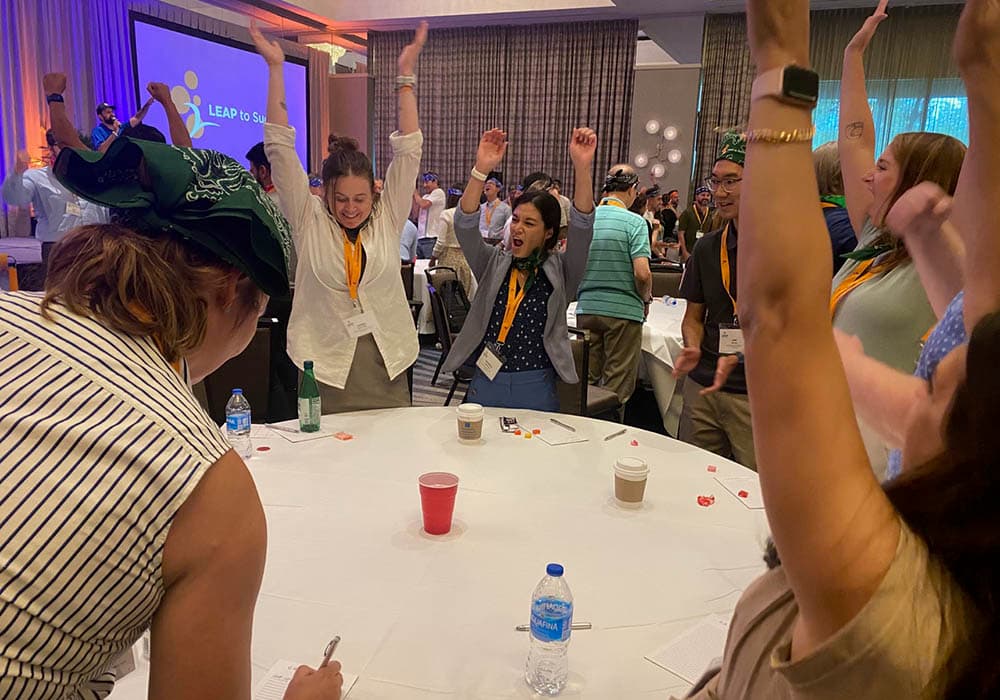
Give everyone a role. The programs that hold a room are the ones where a person who is quiet, or older, or on crutches, has a job that the team cannot win without. Our facilitators say managers routinely see people display abilities in these sessions that surprise everyone, the person included, which is the point: the event is a chance for the room to see each other differently, and the facilitator's job is to make sure it does. That includes recognition out loud. The winning team is named, the person who solved the puzzle is named, the team that finished the wheelchair first hands it over in front of everyone. Certificates and medals are fine, and the value is in the naming.
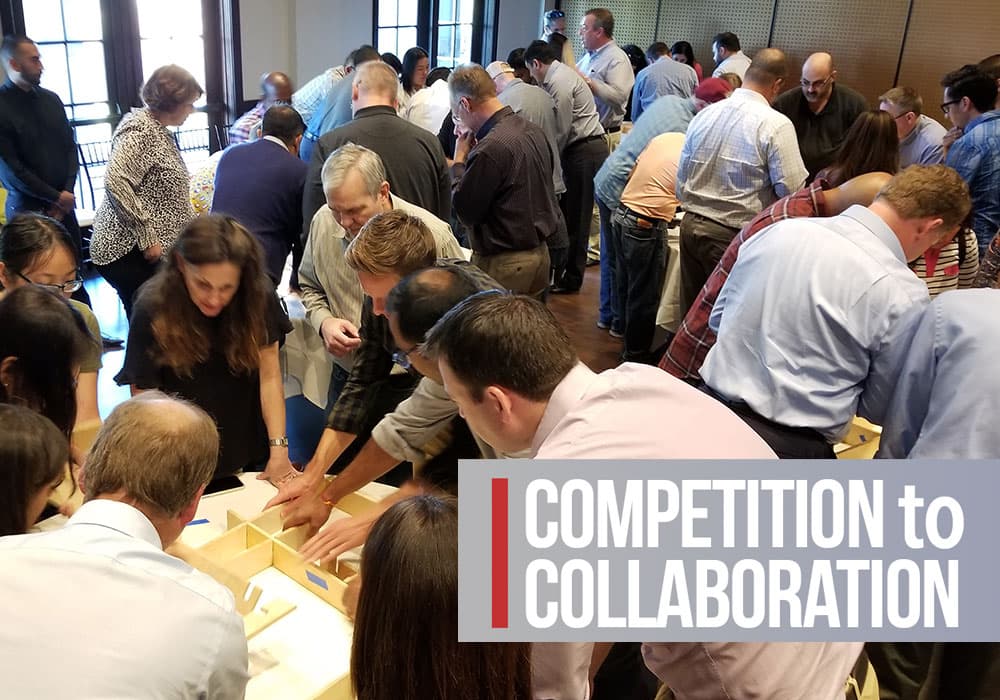
Then decide what the leaders do. Roy's advice to clients is that a leader should either play as a full member of a team or stay away, because a leader observing from the side changes how everyone else behaves. Some programs, Competition to Collaboration among them, are built with pause points where a facilitator can pull the room together to discuss what just happened; a build or a hunt is not, and a leader who wants those conversations should book the right format rather than interrupt the wrong one. Finally, close with a debrief that asks two questions and lets managers answer last: what have you brought to the teams you have worked with, and what can people count on you for. Twenty minutes, and it is the part people quote afterwards.
Cadence, and how to measure it honestly
One event is a morale boost. A schedule is an engagement program. Measure it with the survey you already run, before and after, and count the things you can count.
The cadence that works for most companies is one event a quarter, alternating kinds: a game show, then a build, then a charity program, then something outdoors or in the city. A team gets four shared stories a year, no single event carries the weight of the whole culture, and the calendar does the reminding. Companies with a small budget run two, one in spring and one at year end, and put the rest into a monthly habit that costs nothing, such as a twenty-minute debrief in the staff meeting. What does not work is the annual event that everyone dreads because it is the only one.
Measure it with what you already have. Most companies run an engagement or pulse survey; note the score before the first event and the score two quarters later, and look specifically at the connection and recognition items, because those are the ones an event can move. If there is no survey, a confidential ten-question wellness survey before the program and a three-question one 48 hours after gives a baseline and a reading. Alongside the survey, count the things that are countable: attendance as a share of the invited, the number of people who joined from outside the office, participation in the debrief, and, over a year, regretted turnover in the teams that took part against the ones that did not.
What we will not do is hand you an engagement statistic we cannot verify. Every program closes with a facilitator debrief, and we will share what the room said. The number belongs to your survey. If a vendor quotes you a percentage improvement in engagement from a single event, ask for the study.
| Measure | When | Where it comes from |
|---|---|---|
| Connection and recognition items on the engagement survey | Before the first event, then two quarters later | Your existing survey |
| Ten-question wellness baseline | Two weeks before the program | A confidential survey; we can supply the questions |
| Three-question read | Within 48 hours of the event | Same tool |
| Attendance as a share of invited; remote joiners as a share of remote staff | The day of | The roster |
| What the room said in the debrief | The day of | The facilitator's notes, shared with you |
| Regretted turnover, participating teams vs the rest | Twelve months on | HR records |
What a departure costs, and what an event has to do
Losing one person costs half to twice their salary. Spending the money on the right pile is the hard part.
Gallup's estimate of replacement cost puts a departing $70,000 employee at $35,000 to $140,000 in recruiting, ramp time and lost output. The comparison is honest only if the event is aimed at the pile it can move: if the team is leaving over pay or the manager, the events will be pleasant and the people will still leave. If the team is leaving because it has no ties to anyone in the building, four afternoons a year that build those ties are the cheapest retention lever available.
A last word on where the money goes. About a tenth of the events we have run since 2023 were for groups under fifty at the client's own office, no venue, no travel, the facilitator comes to you. That is the format for a manager with a modest budget and a real morale problem, and it is the one we would recommend first.
From our events
Sources
- Gallup, State of the Global Workplace 2024
- Gallup, US employee engagement indicator
- Gallup, State of the American Manager
- Gallup, This fixable problem costs US businesses $1 trillion
- McKinsey, The Great Attrition is making hiring harder
- Bureau of Labor Statistics, Employee tenure summary
- Harvard Business Review, What matters more to your workforce than money
- US Surgeon General, Framework for workplace mental health and well-being
- Project ROI, Babson College
- Oxford Wellbeing Research Centre, Workplace wellbeing and firm performance
- The Conference Board, Job engagement declines for a third of workers
- HRO Today, Nearly half of companies anticipate layoffs in 2025
- BEST, 10 Business Scenarios Where Team Building Leads to Success (eBook)