What charitable team building is
A charitable program is a team event whose output goes to someone else: the team builds, packs or wins something, and a nonprofit takes it home. The building is the team building; the handoff is the point.
There are four shapes. Build-and-donate programs, where teams assemble bikes, wheelchairs, rollators, guitars or wagons from kits and the finished goods go to a charity. Care-kit programs, where teams pack backpacks, care packages, sensory kits or comfort bags to a list the receiving agency supplied. Charity game shows, where teams compete and the winning team's cause receives a check. And charitable scavenger hunts, where the route reveals the donation at the end. The first two are three-quarters of what we run, because the physical object in a participant's hands is what people remember.
Every real charitable program has a named recipient before the event, goods that actually reach that recipient, and a handoff the room can see or at least hear about. A program that ends with a vague promise to donate later is a team building event with a slogan on it.
From our events
What the research says giving back does for a workforce
The evidence for charitable programs is stronger than for any other kind of team building, because it measures something companies already track: whether people stay, and how hard they work while they do.
The largest body of work is America's Charities' Snapshot research with employers and employees. More than 70 percent of employees say a culture of giving and volunteering is important or imperative in a workplace, 82 percent want to volunteer alongside their peers rather than alone, and 88 percent of business leaders say community-engagement programs help them attract and retain people. On the customer side, 92 percent of consumers expect companies to be good corporate citizens, and 90 percent of executives say partnering with a nonprofit enhances the brand.
Project ROI, a Babson College review of the research on corporate responsibility, put numbers on the workforce effect: a well-run program can raise engagement by up to 7.5 percent, productivity by up to 13 percent, and cut turnover by as much as half. Harvard Business School's own summary of the field found that 90 percent of executives believe a sense of purpose drives employee satisfaction, while fewer than half of companies say they operate with one.
The one finding worth underlining, because it decides how you should run these events, is about consistency. Firms with a low but steady level of social performance outperform firms that make occasional big gestures. A bike build every March beats a spectacular one every third year.
| Finding | Source | What it means for a planner |
|---|---|---|
| 70%+ of employees say a giving culture is important or imperative | America's Charities, Snapshot Employee Research | The program is for them, so let them pick the cause |
| 82% want to volunteer with their peers | America's Charities, Snapshot Employer Research | A team build beats a solo volunteer day |
| 88% of leaders say engagement programs help attract and retain | America's Charities, Snapshot Employer Research | Budget it as retention, and measure it that way |
| Engagement +7.5%, productivity +13%, turnover down 50% at the top end | Project ROI, Babson College | The ceiling, for a consistent program |
| Steady social performance beats occasional spikes | Project ROI, Babson College | Same cause, same season, every year |
Pick the cause: one, close to the business, repeated
The cause that works is the one your people can explain in a sentence, that connects to what the company does, and that you will come back to next year.
The mistake is choosing a cause because it is available. Start instead from the business: a food company packs for a food bank, a healthcare company builds rollators or autism kits, a technology company sends STEM backpacks to a school, a company with a veteran hiring program packs military care kits. When the connection is obvious, nobody in the room has to be told why they are there, and the story writes itself internally and externally.
Then repeat it. America's Charities' seven rules for corporate giving are committed, authentic, consistent, genuine, deliberate, strategic and practical, and the operative one is consistent. Pick one cause, commit to a schedule rather than an amount, name the charity, and publish the running total inside the company. By the third year it stops being an event and becomes the thing the company does. Our own records say the same: companies whose first event with us was charitable come back at the same rate as everyone else, and when they do, two in three choose a charitable program again.
| If the company | A cause that connects | Programs built for it |
|---|---|---|
| Makes or sells food and drink | Hunger, local food banks | Mini-Golf Build and Food Donation, Donation Nation |
| Works in healthcare, pharma or insurance | Patients, mobility, children's hospitals | Build-a-Rollator, Pediatric Care Donation, Autism Sensory Donation, Cancer Comfort Care Packs |
| Works in technology or engineering | STEM education, schools | STEM Backpacks, Earth Wind and Solar, We Care for Schools |
| Hires or honors veterans | Deployed service members, disabled veterans | Operation Military Care, Build-a-Guitar for Guitars 4 Vets |
| Serves families and communities | Children in crisis, families without homes | Bike Build Donation, Bears and Blankets, Helping the Homeless, Kids Rock |
| Wants the whole company to choose | The winning team's cause | Charity game shows, Locate and Donate SmartHunt |
Roy's rule
Pick the format: what gets built, and for whom
Bikes for the biggest rooms and the biggest reveal, wheelchairs and rollators for a build with weight to it, care kits when the group is mixed or the time is short, game shows and hunts when the donation is a check.
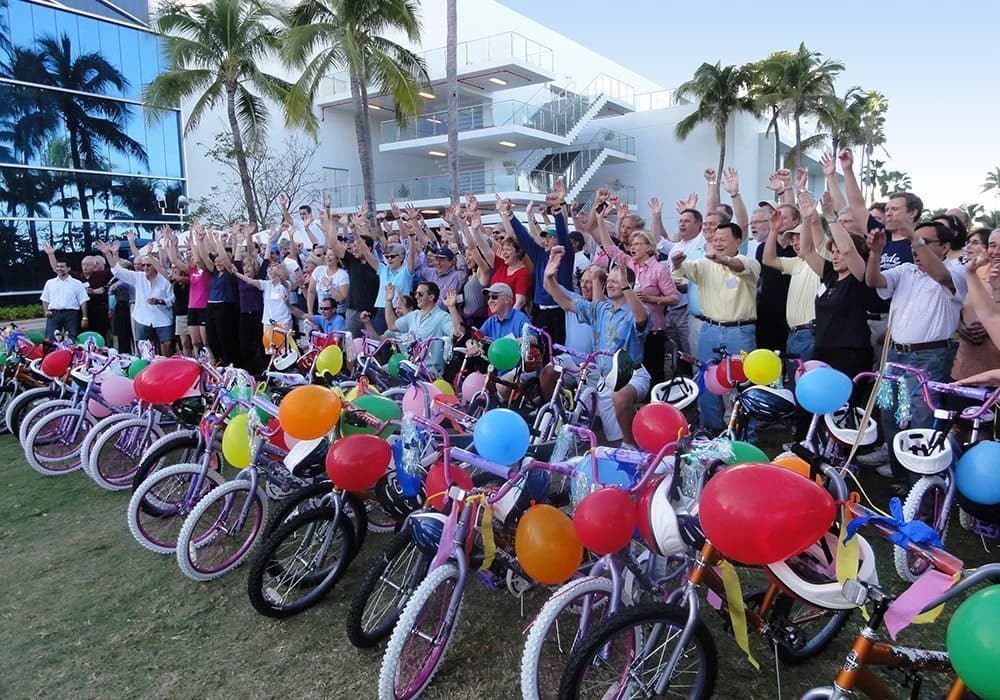
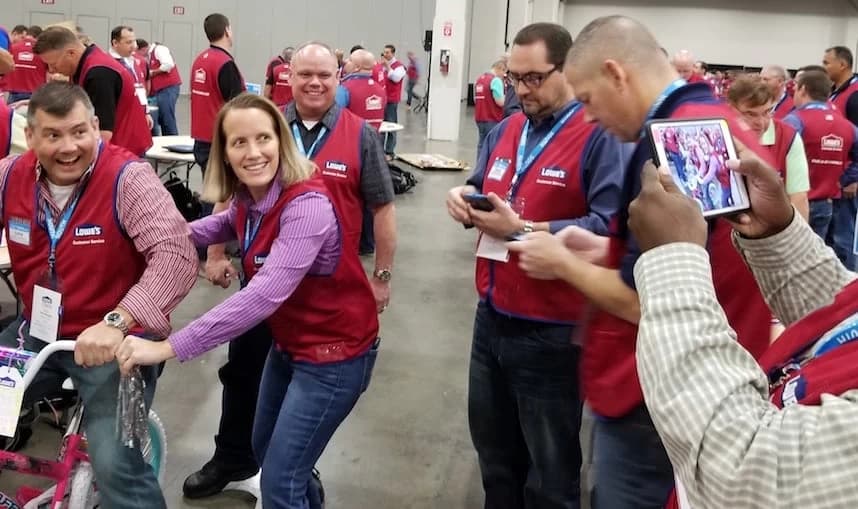
Bike Build Donation is the activity we run most, by a wide margin, and the charity build most groups choose. Teams of ten earn parts through challenges, build a twenty-inch bike, write a note to tie to the handlebars, watch it pass a safety inspection, and, when the receiving club can bring them, hand it to the child who will ride it. It scales to a ballroom of 3,500 and it is the reveal people talk about for years.
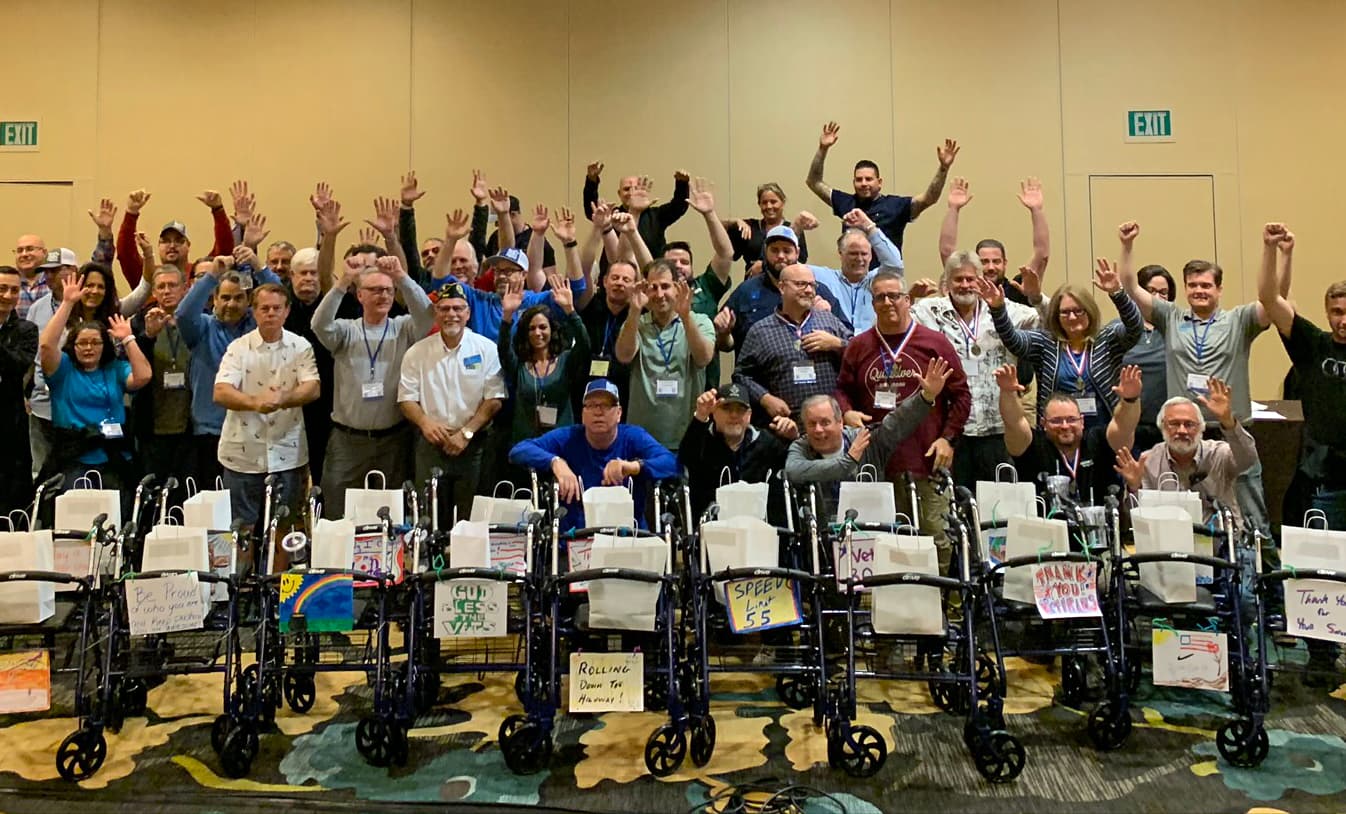
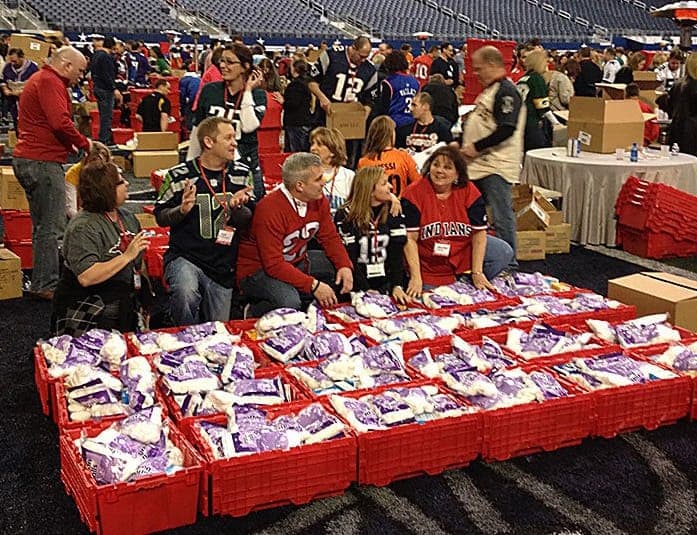
Wheelchair and rollator builds have a different weight, literally and otherwise: the recipients are veterans, patients and elders, and the moment a veteran sits in a chair a team just built is the quietest a corporate room ever gets. Care-kit programs, from STEM backpacks and military care packs to bears and blankets and sensory kits, fit a shorter slot and a group with a wide physical range, and they let the receiving agency specify exactly what its people need. Guitar and band builds go to school music programs and to Guitars 4 Vets. And when the group would rather compete, a charity game show or a Locate and Donate hunt ends with a check to the cause the winning team chose.
By our own count from participant records, the builds since 2019 come to something like 13,000 bikes and 2,000 wheelchairs and rollators, plus tens of thousands of care kits. Those are estimates from headcounts, since the goods are counted at the event and never entered in a database, which is one of the things this guide's author would like to fix.
| Format | What is built or packed | Who receives it | Team, time, space | Best when |
|---|---|---|---|---|
| Bike Build Donation | 20-inch bikes with helmets and locks | Boys and Girls Clubs, youth agencies, often in the room | 10 per team, 1.5 to 2 h, 25 sq ft a person | The reveal matters; any size up to 3,500 |
| Build-a-Rollator, wheelchair builds | Rollators or wheelchairs with a care kit | Disabled American Veterans, hospitals, elder care | 10 per team, 1.5 to 2 h, 25 sq ft | A serious group; veterans or healthcare |
| Care kits (STEM backpacks, military care, bears and blankets, sensory, comfort packs) | Kits packed to the agency's list | Schools, HeroBox, children in crisis, hospitals | 8 to 10, 1 to 2 h, 25 sq ft | Short slots, mixed groups, a specific agency need |
| Build-a-Guitar, Build-a-Band | Electric guitars, basses, drum kits | School music programs, Guitars 4 Vets | 10, 2 to 2.5 h, indoors | A creative group and a room with power |
| Mini-Golf Build and Food Donation | A playable course, then the food it was built from | Local food banks | 10, 1.5 to 2 h, 35 sq ft | Food companies; a competitive room |
| Charity game shows, Locate and Donate | A check to the winning team's cause | The charity you name | 6 to 10, 1 to 2.5 h | The group wants to compete; the donation is your budget, on top of the fee |
How the donation actually reaches the recipient
The nonprofit is chosen before the event, the goods come from our own warehouse, the build happens in your room, and the handoff is either in person that afternoon or shipped to the agency's door.
Before the event, BEST's charitable coordination team matches the program to a nonprofit: what they need, how many, where it goes, and who can come. You can name your own charity, or we place the donation with a partner near the venue; more than 280 nonprofits have received goods from our programs, from national partners like St. Jude Children's Research Hospital, Boys and Girls Clubs of America, Family Promise, HeroBox, Disabled American Veterans, the YMCA, CASA and Guitars 4 Vets, to the food bank two miles from your hotel.
The materials ship from our warehouse to the venue, usually to arrive two to three business days before the event: bike frames, wheelchair and rollator kits, backpack contents, care-pack supplies. The build runs on your agenda with our facilitator and staff. Then the handoff. When the agency can bring recipients, the children or the veterans arrive as the last bikes pass inspection, and the room gives them away in person. When it cannot, because the recipients are patients, or the charity routes everything through a central warehouse as St. Jude does through Memphis, the goods are packed, inspected and shipped, and the agency confirms receipt.
One thing we do on purpose: when the recipients are coming, we usually do not tell the participants in advance. A room that has spent ninety minutes building bikes and then sees the kids walk in is a different room from one that knew.
- Which nonprofit, named, and the contact who will confirm the need
- What they need and how many, in their words, before the kits are ordered
- Whether recipients can be in the room, and who is bringing them
- Pickup or shipping: the loading route, the time, the vehicle
- A written acknowledgment from the agency for your records and your internal story
- Photos and permissions, especially where children are present
From our events
What the fee includes, and the tax question
For a build or a kit program the donated goods are inside the fee; for a charity game show or a hunt the check is your budget on top. The tax treatment is a question for your adviser, with the paperwork to support it.
A charitable build from BEST includes the facilitator and staff, the kits and materials, the donation coordination, the shipping to the venue and the handoff. The bikes, wheelchairs, backpacks and care-pack contents are in the fee. The two exceptions are the competitive formats: a charity game show ends with a check to the winning team's cause, and a Locate and Donate hunt reveals a donation at the finish, and in both the amount on the check is set by you and paid on top of the program fee.
On tax: the goods are purchased by BEST and donated at the event, and whether any part of what your company pays can be treated as a charitable contribution depends on your situation and your country's rules. We do not give tax advice. What we do provide is the paperwork: a charitable program contract comes with a charity disclosure and BEST's W-9, and the receiving nonprofit can acknowledge what it received. Take those to your tax adviser and let them decide.
When to run it, and at what scale
The first quarter and October are the charitable seasons, December belongs to the holiday party, and the format scales from thirty people to a ballroom of 3,500 without changing what the team does.
The calendar surprises most planners. Charitable events cluster in January through March and again in October, when kickoffs and national meetings happen; November and December carry fewer charitable events than the rest of the year, because those months are holiday parties and year-end pressure. If you want a give-back tied to the holidays, book it for early November, when the agencies are also planning their own season.
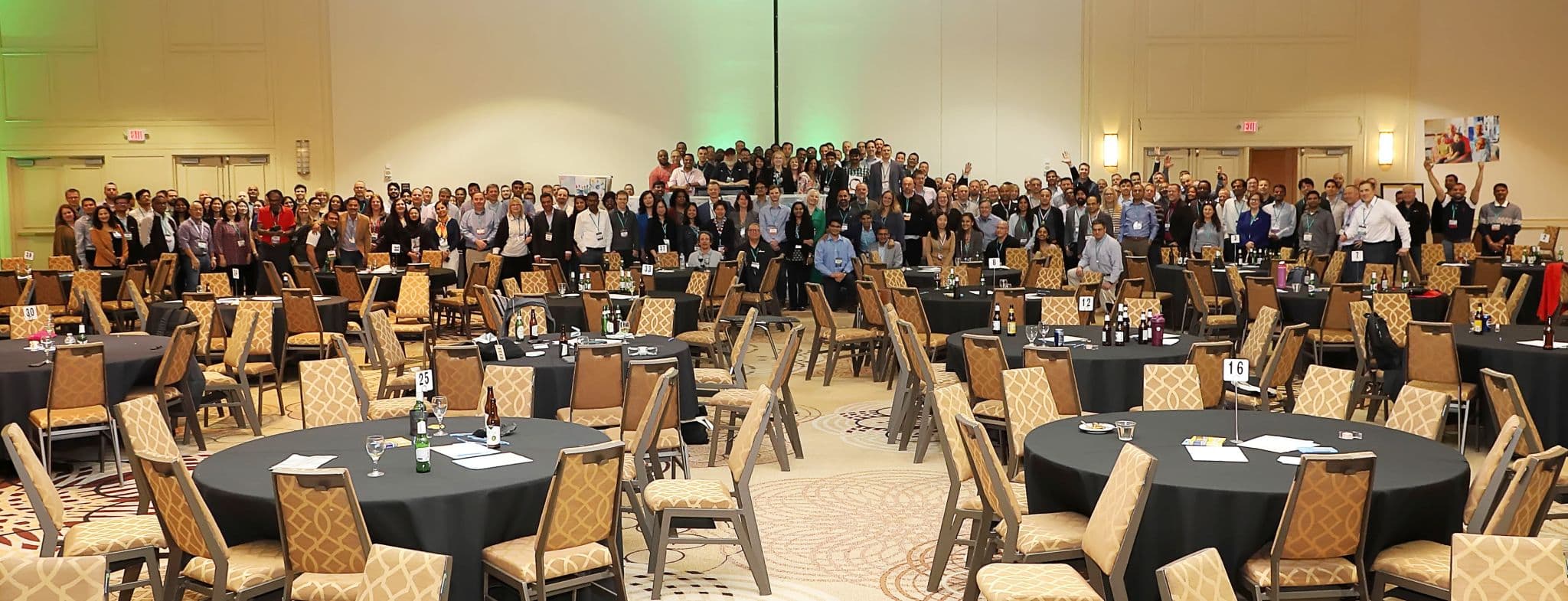
Lead time runs longer than for other programs: a charitable event is signed a median of 32 days before the date, against 22 for everything else, because the nonprofit has to be matched and the goods have to ship. Above 250 people that stretches to about six weeks. At scale the format holds: Lowe's built 1,048 bikes with 3,500 managers in one afternoon, Shell ran 500 people a year through 25 stations in waves, and Ciena ran five builds side by side, and inside all of them the working unit stayed a team of ten and a kit.
From our events
Make it count beyond the afternoon
The event is two hours; the value is in what the company does with it in the year that follows.
Tell the story inside the company first: the number built, the agency's name, a photo of the handoff, and the quote from the recipient. Then publish the running total, every year, so that by the third year employees can say what the company has given without looking it up. Tell it outside the company with the nonprofit's permission and, where children are involved, only with the agency's photo rules in hand.
Bring the commitments from the debrief to the next team meeting with names on them, and put the next event on the calendar before this one is forgotten. Companies that treat the give-back as a schedule rather than a gesture are the ones whose numbers move, and they are the ones who call us back.
- The count, the agency and a photo of the handoff, sent to the whole company within the week
- A running total the company keeps and repeats every year
- The nonprofit's written acknowledgment on file
- External stories only with the agency's permission and photo rules
- The debrief commitments, with owners, on the next team meeting's agenda
- Next year's date held, same cause
Sources
- America's Charities, Snapshot Employee Research: What Employees Think About Workplace Giving, Volunteering and CSR
- America's Charities, Snapshot Employer Research: Corporate DNA, Employee Engagement and Social Impact
- Project ROI (Babson College), Defining the Competitive and Financial Advantages of Corporate Responsibility and Sustainability
- Harvard Business School Online, Corporate Social Responsibility Statistics
- Best Corporate Events, signed event records 2019 to September 2026 (charitable share, program counts, lead times)
- Best Corporate Events, The BEST Guide to CSR and Charitable Team Building (eBook)