What changes above a hundred people
Three things: the room becomes the constraint, the facilitator becomes a production, and the agenda slot becomes the biggest risk on the day.
A program for thirty people is a facilitator, a box of materials and a corner of a room. The same program for six hundred is sixty teams of ten, a ballroom measured in square feet per person, a sound system the back wall can hear, a crew of thirty, a truck, and a ninety-minute window on a conference agenda that somebody else controls. The activity is the same. Everything around it is different, and the planning has to start from the room and the clock rather than from the catalog.
The good news is that a large group is mostly a lot of small ones. Inside any format that works at scale, the working unit stays a team of eight to ten, because that is the largest group in which everyone has to speak. A ballroom of six hundred is run as sixty tables, each with its own supply station, and the crowd never has to act as a crowd.
From our events
The formats that scale, and why
Only a few formats survive contact with a thousand people: parallel builds, a hosted show, a hunt that uses the city as the room, and several programs run at once.
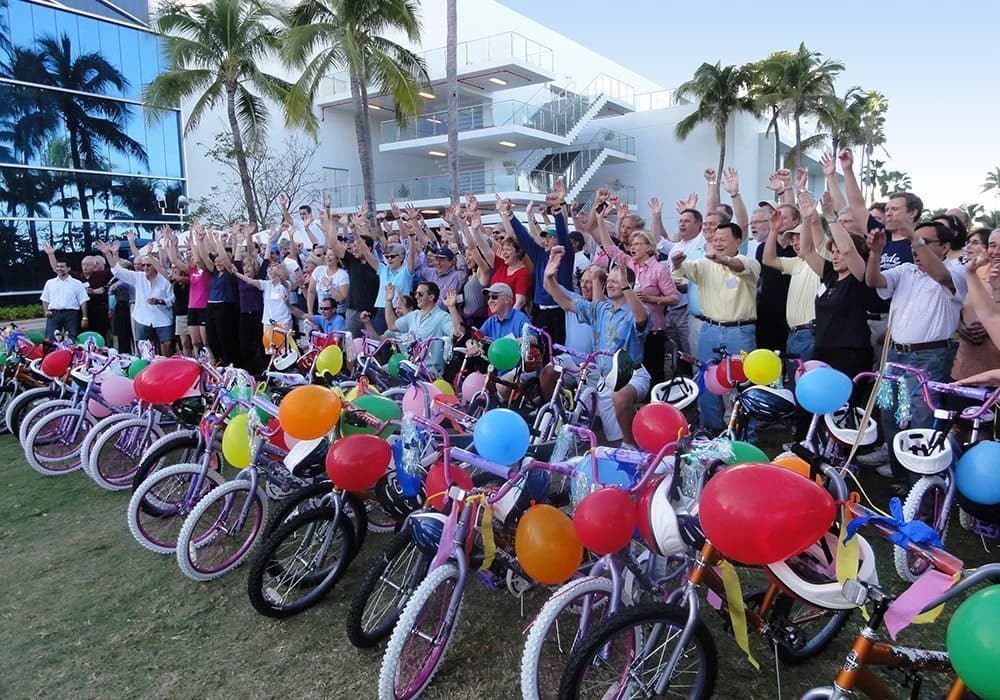
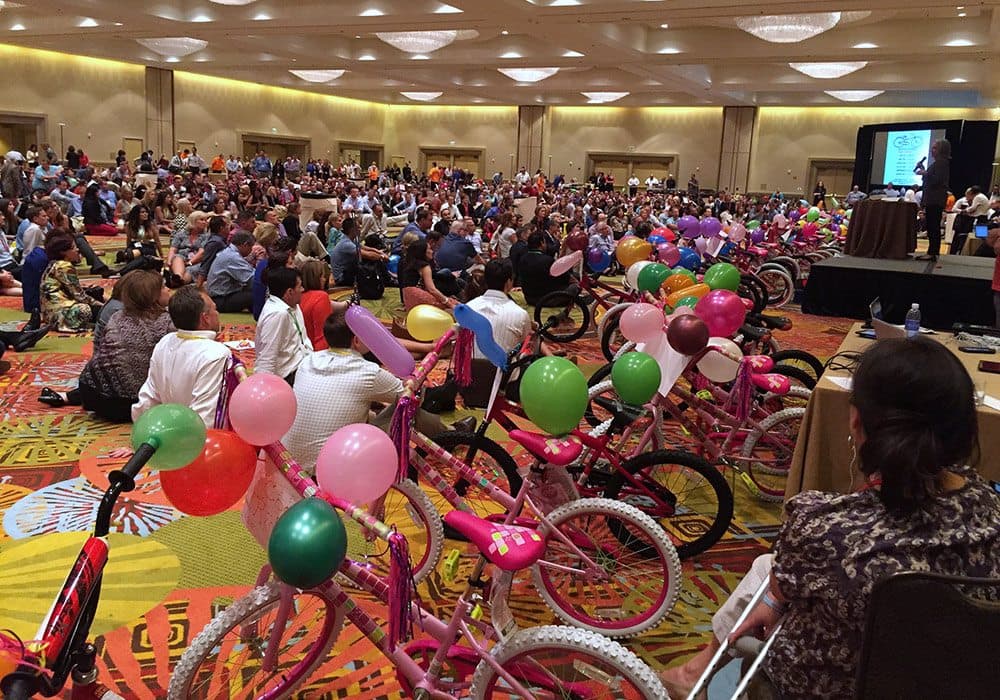
Charitable builds scale because the work is parallel. Every table builds its own bike, wheelchair or care kit, earns parts at a supply station, and the crowd is fifty teams working side by side rather than one crowd. A third of our large events are builds, and the biggest events we have ever run are builds.
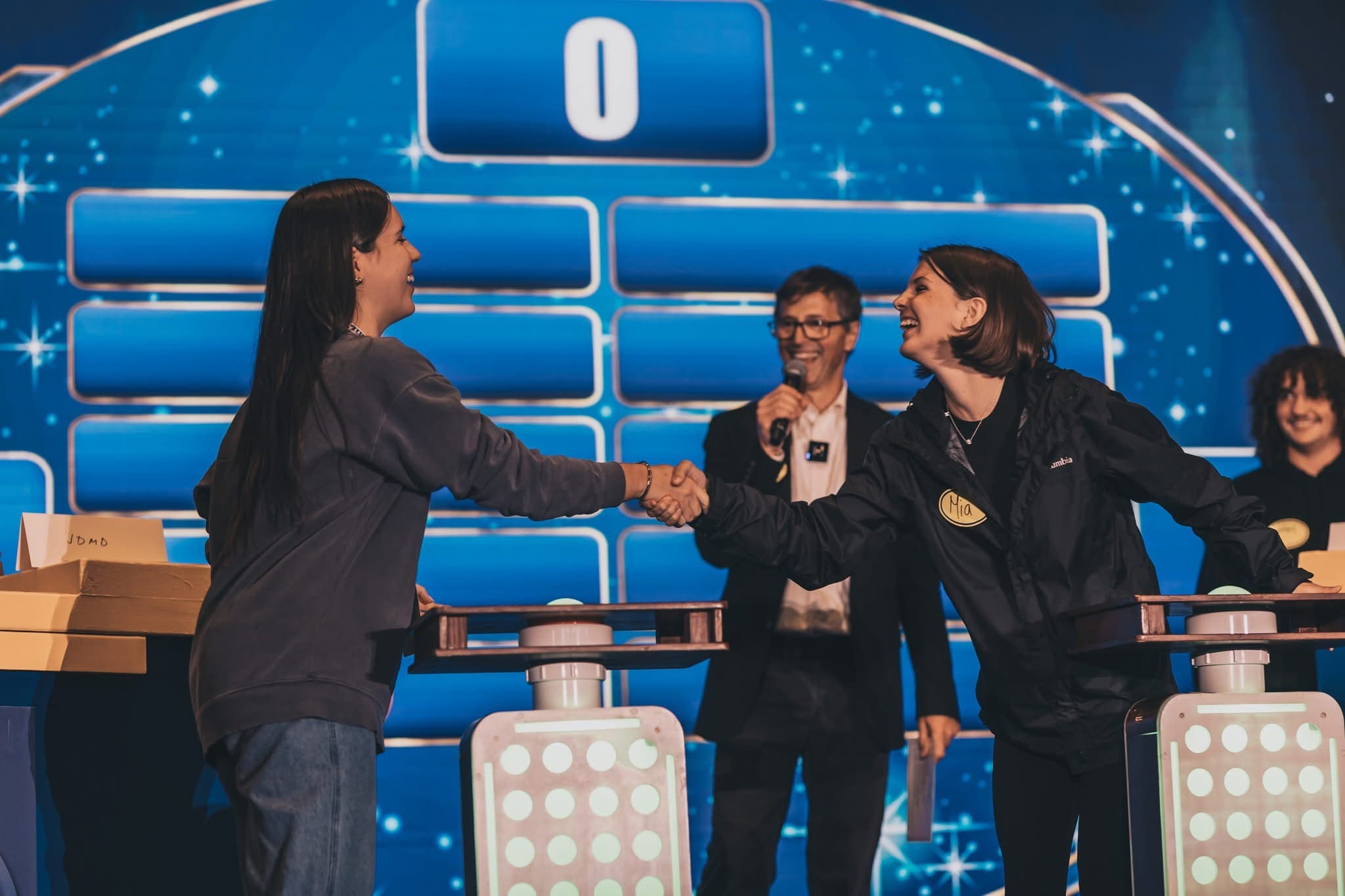
Game shows scale because one host can run a thousand people from a stage, with audience-response handsets replacing the shouting once the room passes a hundred. A fifth of our large events are game shows, and they are the format of choice for an opening or closing session because they fit an hour and need no floor space beyond the seating.
Scavenger hunts scale because the city is the room. Teams leave the venue with an iPad each and the venue's capacity stops mattering; the constraints move to buses and the finish-line slideshow. The largest hunt we have run put 1,800 people on Hollywood Boulevard at once. Above that, and for any group whose members want different things, the answer is several programs at the same time, which has its own chapter below.
| Format | Why it scales | Team size | Comfortable ceiling |
|---|---|---|---|
| Charitable builds (bikes, wheelchairs, care kits) | Parallel stations; every table is its own event | 10 | 3,500 in one room, in waves |
| Game shows (Feud, Trivia, Jeoparody) | One host on stage, audience-response handsets above 100 | 6 to 10 | 2,500 seated |
| Scavenger hunts (City, Amazing Chase) | The city is the venue; one iPad per team | 8 to 10 | 1,800, with buses |
| Networking and mixers (Speed Networking) | Timed rotations; the format is the crowd control | 6 to 8 | 1,400, including virtual |
| Olympics and outdoor challenges | Stations in a rotation; needs 50 square feet a person | 12 to 15 | About 1,000 with the space |
| Custom training and simulations | Designed for the room; the most staff per head | Varies | 2,500 with a production team |
The room: square feet, sound and a loading dock
Size the room at 25 square feet a person for builds and game shows, 30 to 40 for team challenges, 50 for anything with a rotation, then add a sound system, a screen and a way to get a truck to the door.
The square-footage figures are the ones our program managers use to say yes or no to a room, and they assume rounds of ten with a supply station and walking space between tables. A ballroom listed at 6,000 square feet holds a 240-person build comfortably and a 120-person Team Olympics, and the difference is entirely the space each team needs to move.
Sound is the thing most venues underestimate. Past fifty people the facilitator needs a wireless microphone and speakers the far corner can hear, and past a hundred a game show needs audience-response handsets so the scoring is real. Builds need a screen so the room can see the leaderboard and, at the end, the slideshow. None of this is exotic; all of it has to be in the venue contract, because a hotel's house system is often a single ceiling speaker.
For a build, the truck matters as much as the room. Materials for a thousand-person bike build fill a trailer, arrive two to three days before the event, and need a loading dock, a freight elevator big enough for a pallet, and a route from the room back to the truck for whatever is being donated. A venue that closes the day before, or a hotel that refuses freight, is a problem to solve at contract, and it is solvable if it is known.
| Format | Square feet per person | Sound | Also needs |
|---|---|---|---|
| Charitable builds | 25 | Wireless mic and speakers above 50 people | Screen for the leaderboard; loading dock; supply-station tables |
| Game shows | 25 | Mic and speakers above 50; audience-response handsets above 100 | Projector or screen; a stage or riser in a big room |
| Competition to Collaboration, Igniting Team Performance | 30 | Mic and speakers | Rounds of 8 to 10 with table space for materials |
| Bridge to the Future | 40 | Mic and speakers | 50 feet of clear floor for the finished span |
| Team Olympics, Corporate Survivor | 50 | Mic and speakers above 100 | Open floor or lawn for the station rotation |
| SmartHunts | A start and finish room | Mic for the briefing and awards | Wi-Fi for the leaderboard; buses if the route starts elsewhere |
- Square footage against the format, with the tables and chairs the venue actually has
- Wireless microphone and speakers rated for the room, on the venue contract
- Screen or projector the back row can read
- Loading dock, freight elevator, pallet route, and a parking spot for a truck
- Setup and teardown windows, and whether the room is exclusively yours
- Freight acceptance: the venue will receive and hold materials two to three days ahead
- An indoor backup for anything planned outside, with a go or no-go time
Staffing and materials: what a big room actually takes
Plan on one staff member for roughly every twenty participants, a supply station for every five to seven teams, and one iPad per team, all of which the company you hire should bring.
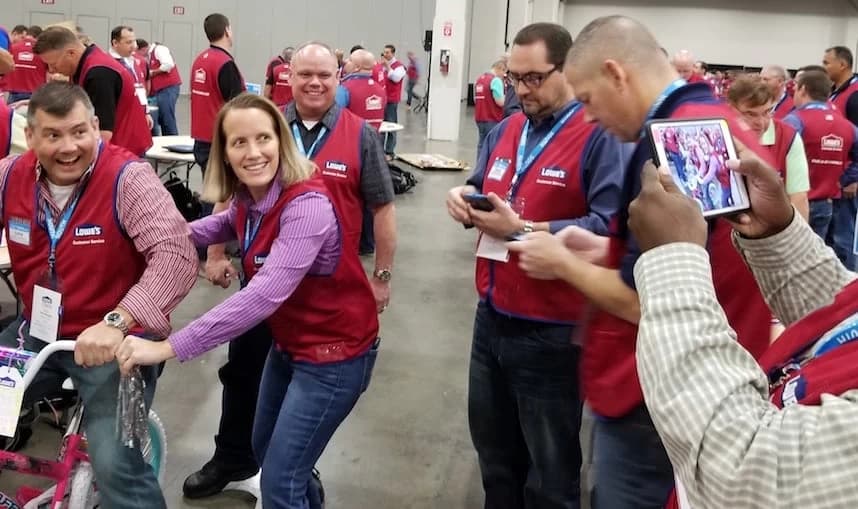
The Lowe's build is the cleanest example of the arithmetic. Three thousand five hundred managers, 180 BEST staff on the floor, 500 sets of tools, and a safety inspection on every one of the 1,048 bikes before a child touched it. That is a staff member for every twenty people and a tool set for every seven, and the ratios hold, give or take, for any build. A game show needs far fewer people per head, because the host does the work from the stage and the staff run handsets and scoring; a hunt needs staff at the stations and at the finish.
Materials scale exactly. A supply station for a build serves five to seven teams; a bike needs a box, a tool set and a helmet and lock to go with it; a hunt needs an iPad per team from a fleet of more than four hundred. The right question to ask a vendor is what they bring and what they need from you, and the right answer for a large group is that they bring everything except the room, the sound and the food.
| Item | Count | Ratio |
|---|---|---|
| Participants | 3,500 | In teams of 10, about 350 tables |
| BEST staff on the floor | 180 | One for every 20 participants |
| Tool sets | 500 | One for every 7 participants |
| Bikes built, inspected and donated | 1,048 | One for every 3 to 4 participants |
| Time on the floor | One afternoon | Inside the national sales meeting |
From our events
The agenda slot: where a large-group program goes in a conference
Mid-afternoon on the middle day is the slot that loses nobody. Openers run an hour, afternoon blocks two, and the closing slot is the one to avoid unless every flight leaves the next morning.
More than half of our large events start between noon and five, and the slot decides attendance more than the program does. A program before lunch competes with lunch. A program as the last item of a conference competes with the airport, which is how a well-run give-back can end with a quarter of the room already gone. The afternoon block on the middle day, after the heavy sessions and before the dinner, is where the whole room is still there and still awake.
Each slot has formats built for it. An opener needs to be fast and seated: a game show or a Speed Networking hour that puts strangers at the same table. The afternoon block is where the builds and the hunts go, because they need two hours and floor space. The evening wants something loud with food nearby, a Feud or a Food Truck Face-Off. And a sales kickoff can be given its own edge: a game show whose questions come from the week's sessions, or Competition to Collaboration, which opens with the sub-teams competing and turns into an argument for sharing what each of them knows.
| Slot | Length | Formats built for it | Watch for |
|---|---|---|---|
| Opening session, day one | 1 to 1.5 hours | Jeoparody Live, Trivia Blast, Speed Networking | The room is still arriving; seat people as they come |
| Afternoon block, middle day | 1.5 to 2.5 hours | Bike Build, Build-a-Guitar, Bridge to the Future, STEM Backpacks | Load-in has to finish before the morning sessions |
| Evening | 1 to 2.5 hours | Best Corporate Feud, A Minute 2 Win It, Food Truck Face-Off | Alcohol first, program second, never the reverse |
| Off-site | 2 to 2.5 hours plus transit | City SmartHunt, Amazing Chase | Buses each way and a finish with the slideshow |
| Closing session | 1 to 1.5 hours | A game show, if anything | The airport wins; move the give-back earlier |
From our events
Several programs at once
Above about 800 people, or whenever the group wants different things, the answer is two to six programs running side by side, each with its own facilitator, room, staff and, for a build, its own charity.
About a quarter of our large events are multi-program days, and some are six programs deep. The pattern is the same each time: attendees register for the program they want ahead of the event, each program gets a room sized for its share, each has its own facilitator and crew, and the whole thing starts and ends on one clock so the group reconvenes together. It is more work for the planner and much better for the participant, because a competitor and a builder each get the afternoon they would have chosen.
What multiplies is the logistics. Five programs is five load-ins, five freight deliveries, five sound systems and five sets of staff, and if the hotel wants a security list with every crew member's schedule, it wants five of them. Ciena's kickoff fell on the weekend of the Formula 1 race, which turned shipping, receiving and staff lodging into their own projects. Planning for that event began in July for a November date, and that is the right instinct: a multi-program day wants the same lead time as an event twice its size.
- Pre-registration by program, with caps per room and a wait list
- One room per program, each sized for its share at the format's square footage
- A facilitator and crew per program, with one production lead over all of them
- Freight per program: separate deliveries, one receiving contact, one dock schedule
- The venue's security or credential list, if required, with every crew member on it
- One start time, one finish time, one reconvene point
- A charity per build program, briefed on the pickup time and the loading route
Timeline and budget at scale
Give a large event about three months from first call to event day, expect the contract to be signed roughly five weeks out.
The lead times in our records barely move with size above 250 people: the median large event is planned over about eleven weeks from first record and is signed about five weeks before the day. The difference is what fills those weeks. A thirty-person event needs a date and a room; a thousand-person event needs the venue's freight rules, a security list, a dock schedule, a bus plan, and a headcount that will move by ten percent until two weeks out.
Budget behaves the way the guide to planning describes, only more so. The facilitator, the design and the trucking are largely fixed, so what changes at scale is the list of lines around the program fee, below. Charitable builds are also the format most large groups choose, and the bikes and kits are real goods going to a named charity, which the freight plan has to allow for.
| Line | Why it appears at scale | Who usually pays |
|---|---|---|
| Freight and drayage | A trailer of materials in and donated goods out; the venue may charge per pallet | Client, often via the venue |
| Audiovisual | Wireless mics, speakers, screens and handsets beyond the house system | Client, via the venue or the program |
| Buses | Off-site hunts and any venue away from the hotel | Client |
| Staff travel and lodging | Crews of 20 to 180 on site, sometimes for a load-in day | Included in a BEST quote in the continental U.S. |
| The donation | The bikes, wheelchairs or kits themselves, in bulk | Included in the program fee |
| Security and credentialing | Hotels with a credential list for outside crews | Client, via the venue |
From our events
The day: load-in, waves, the handoff and the exit
A large event is won the morning before, when the truck unloads, and lost in the last twenty minutes, when the donation handoff and the exit are improvised.
Load-in for a build of a thousand starts the evening before or at dawn: the truck to the dock, pallets to the room, stations set with materials counted per team, the leaderboard tested on the screen. Staff brief an hour before doors. The room opens with the icebreaker already running so early arrivals are doing something, teams form by table, and the facilitator's first job is to get a thousand people to hear one voice.
Waves are how a big headcount fits a smaller room or a longer day: Shell ran 500 people through 25 stations by scheduling groups through the afternoon, and a national meeting can rotate three breakout groups through one ballroom. The wave schedule has to be on the agenda in writing, with a fifteen-minute buffer at each changeover and a hard stop, because a room that runs long at scale runs long for everyone after it.
Then the finish. For a build, the charity arrives, the goods are inspected and handed over in front of the room, and the slideshow plays; it is the moment the whole day was for, and it needs a loading route and a pickup time agreed in advance. For a hunt, the finish is the slideshow and the awards, and the buses are already outside. For everything, the exit is planned: where a thousand people go next, and how long the room has before the next session needs it.
- Truck at the dock the evening before or at dawn; pallets to the room; materials counted per table
- Sound check and screen test before doors, with the leaderboard live
- Staff briefing an hour before; every crew member knows their station and their wave
- Icebreaker running as the room fills; teams formed by table
- Wave changeovers with a fifteen-minute buffer and a hard stop, on the written agenda
- Charity pickup time and loading route confirmed; goods inspected before handoff
- The exit: buses, the next session, or dinner, with the room's turnover time known
From our events
Sources
- Best Corporate Events, signed event records of 250 or more participants, 2019 to September 2026 (counts, formats, venues, timing, lead times)
- Case study: Lowe's Bike Build Donation, Sands Expo, Las Vegas, 2018
- Case study: Ciena's five-program kickoff, Las Vegas, 2023
- Case study: Shell's Day of Giving, Houston
- Smart Meetings, feature on SmartHunts and the 1,800-person Prudential hunt on Hollywood Boulevard, 2016