Where remote team building stands now
Virtual team building was most of the industry for two years and is now a small, steady share of it, used by companies whose teams are spread out and by companies that need something in December. Both are good reasons. Nostalgia for 2021 is the bad one.
In 2020 and 2021 about three quarters of the events we ran were virtual, because they had to be. In 2022 that fell to one in five, and since 2023 it has settled at just under one in ten. The companies booking virtual now are a different group from the ones who booked it then. Most are new to us, and they book it because their people are spread across a dozen cities, because the holiday party has to include the field team, or because the date is three weeks away and nobody can travel.
That is the honest frame for this guide. A remote event is a tool for a specific job. It can be booked in half the time of an in-person program, and for a team that is never in one place it is the only way to put everyone in the same activity at the same time. It also does less than an afternoon in a room does. The research below explains why, and the rest of the guide is about getting the most out of the format when it is the right one.
Hybrid is the word people reach for when the team is mostly in one room and a few people are joining from home, which describes nearly every large meeting now. What it needs is a program built so the people on the screen are playing rather than watching, which is the design problem the hybrid chapter below solves.
From our events
What the research says about connection at a distance
Where people work has little effect on how engaged they are. It has a large effect on how connected they feel to each other, and that gap is what a remote or hybrid team building event is for.
The Conference Board's engagement research found that work location has no measurable effect on self-reported engagement; engaged people are engaged from a kitchen table. Gallup's tracking tells the other half of the story. The share of employees who say someone at work cares about them as a person fell from 47 percent in January 2020 to 38 percent. Hybrid workers are the least likely to have a best friend at work, 17 percent against 22 percent in 2019. BambooHR's 2024 return-to-office study found 44 percent of hybrid and in-office employees say their relationship with remote colleagues is weaker than with the people they see.
The flexibility side is settled. Future Forum's pulse of 10,000 knowledge workers found 80 percent want flexibility in where they work and 94 percent in when, and that people with rigid schedules are three times more likely to be job hunting. Buffer's annual survey has 98 percent of remote workers wanting to stay at least partly remote for the rest of their careers. Stanford's Nick Bloom found fewer than half of employees ordered back five days a week are actually complying. A company that hires across the country is a distributed company whatever its policy says, and the team building has to be planned for the company it is.
Two findings decide how to spend the budget. Microsoft's people analytics lead, Dawn Klinghoffer, told HR Brew that in-person time should be reserved for the moments that matter: onboarding, team building and the launch of new projects. And the loneliness research is consistent that face-to-face contact is the strongest remedy, with video a real but weaker substitute. So the pattern that works for a distributed team is a short remote event every quarter or so, plus one in-person gathering a year that everyone travels to. The remote events keep names and faces current. The in-person one does the heavy lifting.
| Finding | Source | What it means for a planner |
|---|---|---|
| Work location has no effect on engagement | The Conference Board | Remote teams are as engaged as anyone; connection is the gap to close |
| Employees who feel someone at work cares: 47% in 2020, 38% now | Gallup | Build events around people learning about each other |
| 44% of hybrid and office workers have weaker ties with remote colleagues | BambooHR, 2024 | Mix the room and the remote joiners on purpose |
| 80% want flexibility in where they work, 94% in when | Future Forum | The team will stay distributed; plan for it |
| Fewer than half comply with a five-day office order | Stanford SIEPR | An event people want to attend fills the room better than a mandate |
| In-person time is for onboarding, team building and launches | Microsoft, via HR Brew | Spend the travel budget on the one gathering a year |
Three situations, three different events
Fully remote, hybrid, and a distributed team meeting in person are three different jobs. Decide which one you are planning before you look at a single program.
The first is fully remote: everyone joins from their own screen. This is the cleanest to run, because every participant has the same experience, and it is what the phrase virtual team building usually means. It suits a team that lives in many cities, a company-wide holiday event that has to include the field, and any date under a month away.
The second is hybrid: a room of people and some number of remote joiners in the same event. The hybrid eBook we wrote in 2023 splits this into three scenarios, and they need different handling. Most people in one room and a few remote, which is the common one and the hardest, because the remote joiners are easy to forget. Several offices, each with its own room, joined together. And a room plus individuals scattered everywhere. In each case the rule is the same: the people on the screen have to be doing the activity, scoring points and making decisions, and never just watching a feed of the room.
The third is a distributed team that has flown in. This is an in-person event with a particular brief. The group may have worked together for two years and never met, so the program has to mix people who know each other only as a thumbnail. Speed Networking, where tables of six change every fifteen minutes, and a hunt or a build that shuffles teams across departments, do this on purpose. Our facilitators say the request that comes in every week is some version of the same thing: we have been apart for a long time, we want something fun, and we want an activity that will naturally mix the long-time people with the new ones.
| Situation | The right shape | What we would run |
|---|---|---|
| Team in many cities, no travel budget | Fully remote, 60 to 75 minutes, hosted | Virtual Best Corporate Feud, Virtual Trivia Blast, a virtual escape room |
| Company holiday event that must include remote staff | Fully remote, one session or two by time zone | Virtual Office Party, Virtual Name That Tune |
| Most people in a room, a few joining from home | Hybrid: one game, one scoreboard, a host for each audience | Hybrid Trivia Blast, Hybrid City SmartHunt, a hybrid game show |
| Several offices, each with its own room | Hybrid: each room is a team, the host joins by video | Remote-hosted SmartHunt, Hybrid Build-a-Rollator |
| Distributed team meeting in person once a year | In person, built to mix people who have only met on video | Speed Networking, a charitable build, a SmartHunt |
| New hires who have only met on video | Remote first, in person when the cohort gathers | Virtual Orientation Game Show, then an in-person onboarding day |
From our events
The formats that hold attention on a screen
A remote event works when there is a live host, a score, and something to do every ninety seconds. The formats that lasted from the ones we built in 2020 all share those three things.
Game shows are the core of it. Best Corporate Feud, Guess That Price, Trivia Blast, Name That Tune and Jeoparody are hosted live by a professional MC on a branded set, run sixty to seventy-five minutes, and take anywhere from thirty to more than a thousand players in teams. The teams confer in breakout rooms or on a side channel, and answers come in through a phone or a browser page, so the whole event runs on the video platform your company already uses. Up to five rounds can be written about your own company, which is the part people talk about afterwards.
Escape rooms and hunts are the collaborative option. In Escape the Office, Save the Boss or Pharaoh's Quest, teams of four to six solve linked puzzles in a browser to find a four-digit code, with a game master watching every team's progress and nudging the ones that stall. Treasure Hunt: The Cave does the same as a story. These are the ones to choose for a team that would rather work a problem together than buzz in against each other, and they can be played asynchronously across time zones.
Speed Networking is the one to pick when the goal is that people meet. A host and a technical facilitator run four to six breakout rounds. Each round is a small group with a prompt, and the groups reshuffle so that by the end everyone has had a real conversation with most of the call. Then there are the workshops: Virtual DiSC, Leading Virtual Teams, Building Your Hybrid Team, two to six hours for up to twenty-five people, with materials mailed ahead. Those are training with the team building built in.
| Format | Length | Group size | What each participant needs |
|---|---|---|---|
| Hosted game show (Feud, Guess That Price, Trivia Blast, Name That Tune) | 60 to 75 minutes | 30 to 1,000+ | The video platform, plus a phone or second screen as the answer pad |
| Virtual escape room | 60 to 90 minutes | Teams of 4 to 6, unlimited teams | A browser; nothing to install |
| Speed Networking | 60 to 90 minutes | 30 to 1,000+ | The video platform with breakout rooms enabled |
| Virtual SmartHunt (Mind Games, Treasure Hunt) | 60 to 90 minutes | Up to 100 in one session | The SmartHunts app on a phone plus the video call |
| Virtual Office Party | 60 to 75 minutes | Up to 500, teams of 6 to 8 | A browser; a game master runs the rooms |
| Virtual workshop (DiSC, Leading Virtual Teams) | 2 to 6 hours, often split | Up to 25 | The video platform; materials mailed ahead |

From our events
How a hybrid event actually works
Hybrid fails when the remote joiners are an audience. It works when they are players on a team, with a way to act, a way to score and a way to be seen by the room.
Streaming the room to a video gallery is a broadcast, and nobody remembers a broadcast fondly. The four keys in our hybrid eBook come down to this: both audiences must be able to act, both must be able to score, each must be able to see the other, and each needs a host who is responsible for it. In a hybrid game show that means the MC runs one scoreboard for everyone, in-room teams answer on handsets or phones, remote teams answer on the same page from home, and the host calls on the screen as often as the room.
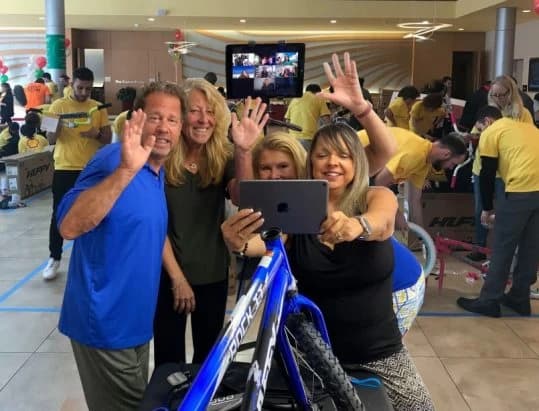
A hybrid SmartHunt is the most worked-out version. The facilitator runs the hunt from a central console and sends both the in-room teams and the remote players into breakouts. Each in-person team carries two iPads, one to play the hunt and one showing the video call with their remote teammates, so the remote players are on the table rather than on a wall. Remote players solve clues, answer trivia and earn points for the in-room team, and the room's cameras broadcast back to them. The photo at the top of this guide is an in-person team taking a selfie with their remote teammates during a bike build.
Charitable programs hybridize well because the physical work can stay in the room and the scoring can go anywhere. In a hybrid Build-a-Rollator, remote teams answer trivia to earn the rollators that on-site staff assemble and donate. The programs that hybridize badly are the ones whose whole content is physical, such as Bridge to the Future or a culinary build, where the remote joiners would have nothing to do but watch. For those, run a separate remote session and connect the two with a shared scoreboard or a shared cause.
- One host responsible for the room and one facilitator responsible for the screen
- A single scoreboard both audiences can see and score on
- A camera pointed at the tables and a microphone that hears them
- The video call on a screen at each table, or on a tablet each team carries
- Remote joiners placed on in-room teams, and named out loud when they score
- Breakout rooms enabled and tested on the company's own platform the day before
- A browser fallback for anyone whose app will not install
- Kits mailed to remote joiners a week ahead if the program has materials
Timing, length and size
Sixty to seventy-five minutes, on a Wednesday or Thursday, starting between three and five in the afternoon Eastern, for about fifty people. That is the median remote event in our records, and each part of it has a reason.
Length first. Attention on a screen runs out at about the hour mark, which is why most virtual programs are written for sixty to seventy-five minutes and the ones that run longer are workshops with breaks built in. Where an in-person program fills an afternoon, a remote one should end while people still want more.
Time of day is a time-zone problem. A three to five p.m. Eastern start reaches noon to two in California and the end of the day in London, which is why more than a quarter of our virtual events start in that window. A team that spans Europe and the US west coast has no hour that suits everyone, and the honest answer is two sessions, or an escape room played asynchronously with the leaderboard closing at the end of the week.
Size is more forgiving than people expect. The game shows and Speed Networking take thirty to over a thousand because the teams do the work in breakouts and the host works the whole call. Under about twenty people, a game show host is playing to a small room, and a virtual escape room, a workshop or a coaching session fits better. Teams of four to six inside the event is the constant across every format. It is the size at which everyone speaks.
| Remote | In person | |
|---|---|---|
| Participants, median | 50; a quarter under 30, a quarter over 80 | 56 |
| Most common weekdays | Thursday 30%, Wednesday 24%, Friday 20% | Tuesday to Thursday, 75% |
| Start time | 3 to 5 p.m. Eastern for 27%; before 11 a.m. for 20% | Set by the meeting agenda |
| Length | 60 to 75 minutes for most formats | 2 to 4 hours |
From our events
How fast it can be booked
A remote event has no venue, no freight and no travel, so it can be contracted and delivered inside three weeks.
What is included is the thing to check with any vendor. A hosted game show should come with a professional host, a second person running the technical side, a tech check on your platform, the custom content and the scoreboard. Ask whether the event runs on your Zoom, Teams or Webex or on the vendor's, whether anything has to be installed, and what happens if a participant cannot get in.
Lead time is the difference. The median virtual event in our records is booked 35 days before it runs and contracted 16 days before, against 57 and 29 for in-person, because there is no venue, no freight and no travel. Two weeks is comfortable for a game show, and a week is possible if the date is open. The exceptions are anything with a mailing, which needs the addresses three weeks out, and December, which fills.
From our events
Running it well, before and after
The event is an hour. The month around it decides whether it lands: who is invited and how, whether the tech works on the first try, and what happens in the days after.
Start with the job. Write one sentence saying why this event exists, whether the new people have never met the old people or the holiday party has to include the field, and choose the format from that. A two-question survey before booking, how connected do you feel to your colleagues and would you rather compete or collaborate, points the way and gives you a baseline.
Make it easy to say yes. Send a calendar invitation from a leader, with the link in the invite and a one-line description that says it is a game show with a host and prizes rather than a meeting. Ask for cameras on, and say why: the host will call on people. And resist stacking these. One of the oldest lessons from 2020 was that a calendar full of compulsory fun breeds resentment, and one good event a quarter beats a weekly happy hour nobody wanted.
Do the tech check. A twenty-minute run on your own platform the day before, with someone from IT on the call, finds the things that go wrong: breakout rooms disabled by an admin, a second-device page blocked by the corporate network, and audio from a conference room that nobody thought to test.
Then close the loop. Send a three-question survey within 48 hours, while it is still fresh, and compare it to the one you ran before. If the team is distributed, put the next one on the calendar before this one is forgotten. A remote event each quarter and one in-person gathering a year that everyone flies to is the rhythm the research and our own records both support.
- One sentence saying why this event exists, written before choosing a program
- A two-question pre-survey for a baseline
- Calendar invite from a leader, link inside, cameras-on request with the reason
- Teams assigned in advance across departments and tenure
- Twenty-minute tech check on your own platform the day before, with IT
- Morning-of reminder listing the phone, the headphones and the link
- Survey within 48 hours; photos and the winning team shared company-wide
- The next date on the calendar, and the annual in-person gathering booked
Sources
- The Conference Board, Job engagement declines for a third of workers
- Gallup, Employee engagement indicator
- Gallup, Hybrid work indicator
- BambooHR, The return to office report (2024)
- Future Forum Pulse, summer 2022 snapshot
- Stanford SIEPR, The great resistance: getting employees back to the office
- Buffer, State of Remote Work 2023
- HR Brew, Microsoft finds in-person settings should be reserved for moments that matter
- Pew Research Center, About a third of US workers who can work from home do so all the time
- US Surgeon General, Our epidemic of loneliness and isolation (2023)
- McKinsey, What is the future of work?
- ResumeBuilder, 1 in 4 companies plan to increase required days in office
- BEST, Four Key Essentials to Making Hybrid Team Building Events a Success (eBook)