It’s commonly said that “employees don’t leave bad jobs; they leave bad bosses” and research backs that up. So the question is: how can organizations that care about things like employee loyalty, retention, and engagement cultivate effective leaders and avoid having bad bosses?
Flipping that expression around, legendary investor and leader Warren Buffet, when asked what the ideal workplace is, gave this answer:
“People ask me where they should go to work, and I always tell them to go to work for whom they admire the most…Do what you love and work for whom you admire the most, and you’ve given yourself the best chance in life you can.”
The Fast Company article showcasing that quote contends that great leaders are “human-centered.” This post looks at the four pillars of human-centered leadership, and how organizations can cultivate those qualities within their management ranks.
Human-Centered Leaders are Focused on Relationships
“It’s not surprising that managers who earn their employees’ trust also build strong, healthy relationships with them. Gallup research confirms this as a key factor for success.”
Strong workplace relationships are built on trust, communication, conflict management, and collaboration. In healthy, high-functioning organizations, top executives push these elements down and across the enterprise.
Developing Effective Communication and Trust
The team at STS states that effective communication is built on active listening, transparency, openness, and emotional intelligence. Active listening is listening to learn, not just waiting for your turn to speak. For most of us, it’s not the way our brains naturally process language, but it is a cognitive skill that can be learned.
Trust is built through transparency and open communication. That means, first, sharing as much information as possible about what is happening in the organization. No one likes feeling out of the loop or that information is being (unnecessarily) withheld. Second, encourage employees to speak respectfully but openly about their observations, issues, and concerns.
Emotional intelligence is another quality that is unevenly distributed (some people seem to naturally have more of it than others) but can be cultivated. In our Emotional Intelligence Training workshop, participants learn how to build trust and encourage open communication through the six major components of EQ.
Conversely, an Inc. magazine article, 7 bad leadership patterns that drive good employees away, and how to fix them, points out that micromanagement and making control more important than trust are hallmarks of bad leaders.
Improving Collaboration
High-performing teams seem to collaborate seamlessly, but that state can be challenging to achieve. There are obstacles like power dynamics, different personalities, generational communication preferences and more to address and overcome.
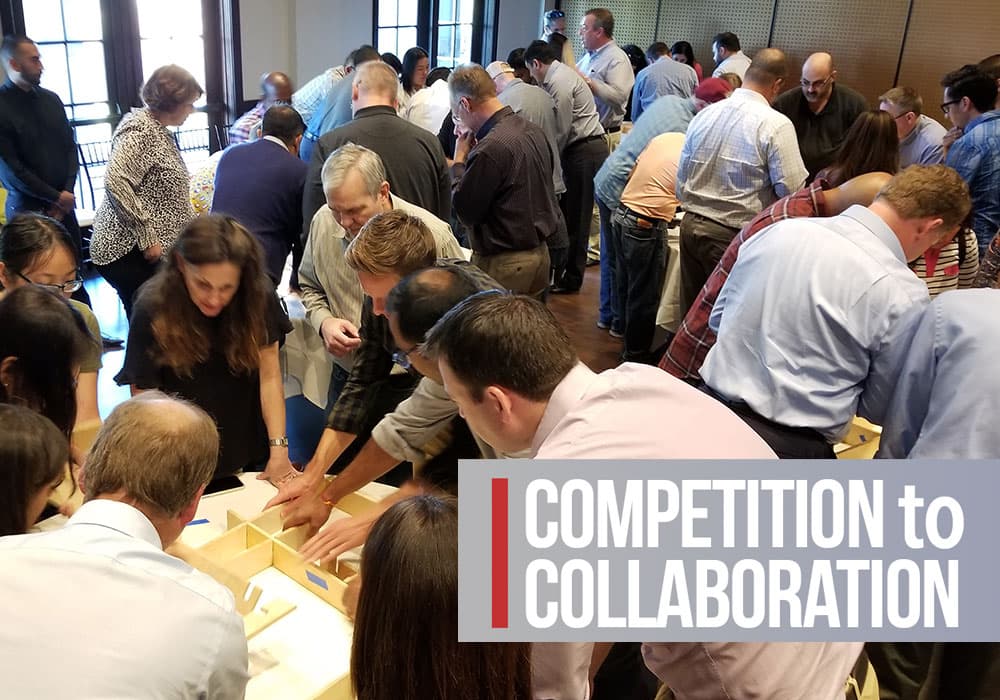
One of the most natural ways to build collaboration skills within and across teams is through fun competition and bonding exercises that take employees out of the workplace and into enjoyable, low-stress situations. Programs like Bridge to the Future and Pipeline develop collaboration skills both within and between groups as teams build sections of a larger structure that need to come together seamlessly at the end.
Our Competition to Collaboration® training program takes this development up a notch as teams start by competing to complete various challenges before facing a surprise twist that reinforces the message of team collaboration.
Managing Conflict Professionally
Conflicts in the workplace are inevitable. But handling them respectfully and constructively rather than emotionally and acrimoniously makes a tremendous difference for maintaining healthy workplace bonds.
Our Conflict Resolution Training workshop teaches participants strategies to handle disagreements and discord with respect and professionalism.
On the other hand, per the Inc. magazine article, in organizations with bad leaders, “difficult conversations never happen. Avoiding conflict is a sure sign of bad leadership. And over time, it slowly destroys relationships.”
Human-Centered Leaders Allow Risk-Taking
“The top priority (is) the need for teams to experience “psychological safety” — a shared belief among team members that the team is a safe place for interpersonal risk-taking, admitting a mistake, asking a question, or offering a new idea.”
Highly effective managers encourage exploration, giving employees freedom to try new approaches and express new ideas. Failure is viewed as part of the learning process rather than something to be avoided at all costs.
This is especially true as AI continues to make a greater impact in the workplace. Organizations that encourage workers to experiment with AI, and create safe spaces for them to do so, will be able to move forward faster with the technology and overcome employee concerns about AI.
Team building programs like Pipeline and Race Car Rally allow employees to take creative design risks in a fun, low-stakes environment outside of work.
Human-Centered Leaders Show Humility
“Humble leaders achieve greatness without arrogance. They shift from ego to humility, which can drastically alter outcomes to their advantage.”
Humble leaders make success all about the team, not all about themselves. One key way to do this, as the team at STS points out, is through recognizing and appreciating employee efforts and achievements:
“Managers who regularly acknowledge and reward their team members for their efforts create a positive and motivating work culture. Whether it’s a simple thank you note, a shoutout in a team meeting, or a small token of appreciation, these gestures go a long way in boosting employee morale and engagement.”
When a team is honored by upper management, humble managers make sure to call out the efforts of specific team members, lifting up their people rather than hoarding credit for themselves.
In contrast, per Inc., bad leaders “have an uncanny ability to make every team success about themselves. Others simply overlook the daily contributions that keep the business moving. Neither builds employee loyalty.”
In addition, under bad leadership, “Ego replaces humility. One of the clearest warning signs of bad leadership is the inability to admit mistakes…The leader serves their own interests instead of the team…(bad) leaders see their role as advancing their own career, protecting their image, or maintaining authority.”
Human-Centered Leaders Make Their Employees Better
“Leadership is about serving others. To evaluate where you stand on the spectrum of a truly human-centered leader, there’s one very powerful question you should ask right now: What am I doing every day to improve the life of an employee?”
The first job of a leader is to guide the efforts of their team to accomplish their goal, whether that is finalizing the design of a new product, launching an ad campaign, closing the books quickly and accurately at quarter end, or some other achievement.
The second job is to develop their people. Investing in employees makes them both more valuable and more loyal to the organization. For example, leadership training is important for employees at all levels, even those with no interest in becoming managers. At the least, employees will be grateful for the investment while improving their communication and collaboration skills.
Professional development workshops and training programs play an obvious role in making employees better. Whether it’s an Essential Supervisory Skills workshop that makes first-time managers more effective, a challenging program to improve communication skills like Total Recall, or a Time Management Workshop that helps employees become more organized and productive, these events enhance employees’ knowledge and skills.
Team building programs more focused on fun and camaraderie rather than formal training can also expand employee talents and capabilities. For example, corporate scavenger hunts require employees to balance competing priorities (maximizing point totals while minimizing time spent) while communicating, negotiating, and navigating. Virtual escape rooms and murder mysteries teach creative problem-solving skills, and are ideal for remote or hybrid work teams.
For bad leaders, on the other hand, “Employees become resources instead of human beings…productivity becomes the only metric that matters, (so) people eventually feel like replaceable parts.”
Final Thoughts on Human-Centered Leadership
Employees disconnect from bad bosses, whether that means leaving the company outright or staying on but disengaging through quiet quitting. But they are drawn to effective, empathic, human-centered leadership.
A Fast Company article defined human-centric leaders as those showing:
- A focus on developing strong workplace relationships;
- A tolerance for and even encouragement of risk-taking;
- An uncommon level of humility and lack of ego or selfishness; and
- A commitment to making their people better through coach and professional development training.
Conversely, per an Inc. magazine piece, bad leaders focus on:
- Exercising control over building trust;
- Getting recognition rather than giving credit;
- Ego (deflecting blame, never admitting mistakes) over humility;
- Viewing employees as resources rather than human beings;
- Avoiding difficult conversations and hoping problems just go away; and
- Serving their own interests over those of the team.
Human-centric leaders value strong communication, trust, collaboration, and creativity. Professional development training and team building programs help expand and enhance these skills among leaders and team members alike. Corporate team building delivers measurable value in terms of improving communication and collaboration, increasing employee satisfaction and retention, raising productivity, and more.
If you’re interested in developing human-centric leaders and strong, high-functioning teams, contact Best Corporate Events to start a conversation. Talk to one of our program advisors about how we help select and even customize a team building activity to help with your organization’s specific situation, whatever that business situation may be.